
Sitting by the Pin River, an icy autumn morning
I have several random memories of drinking from Himalayan waterfalls and streams from early childhood since my father and his siblings always found little brooks and streams to drink from on routine walks during our summer and winter sojourns in the Himalayas. But I don't drink from rivers (even if they are flowing) or lakes or ponds or other standing or flowing water bodies along a relatively flat course. I drink from little brooks or streams that are really high-up and comparatively inaccessible and I always drink off a fall just under a rock or stone, never from a source close to vegetation of any kind or animal trails. Rivers in Trans and Greater Himalayas are generally clean, mineral rich but they would still carry sediments, contaminants, microbes or bacteria that survive in extremely cold climes. States water bodies including rivers are also frequented by native animal populations plus there is always human activity. An important factor is also the constitution and immunity of the individual. City dwellers and plains-bred folk are more likely to be affected by new contaminants since their systems are used to water treated with multiple filtrations. A good rule-of-thumb I have followed since childhood is to do what the locals do. But I do not recommend others to drink from falls or streams. One should always follow their own protocols and stay safe as they would in their usual place of residence because every individual is different, every constitution is different and the ability to adapt is also different (not good or bad, just different). I stopped at this location because I noticed a little bridge made of wooden planks across a narrower section of the river, which meant local villagers cross over here probably on their way to a village on the other side. It was good to be at the river walking along the ancient bed since the river had shrunk to a tiny fragment from its original width and narrower still since it was mid-autumn. In another month, the flow of water would reduce still and there would snow and ice around on large sections of the river bed. It was calming to hear the gurgling tinkle of the water as it enthusiastically rushed over the rocks, pebbles making its way along a broad curved course. The water was mostly deep blue due to the reflection of the wide expanse of the sky, with stretches of bluish-green and deep turquoise at places. I walked along to that stretch and there seemed to be some flora at these stretches. Going by the dried remnants on the stones at the edge of the river, these are high altitude algae. The bluish colour of rivers in Spiti is also on account of diatoms and finely ground minerals that are carried due to glacial snowmelt. Sitting on a rock, listening to the water, feeling the ice cold breeze that was blowing gently and gazing at the rugged mountains and snow-capped far mountains is meditative for me - I see visions and my imagination runs free. It is easy to lose track of time and quite desirable.
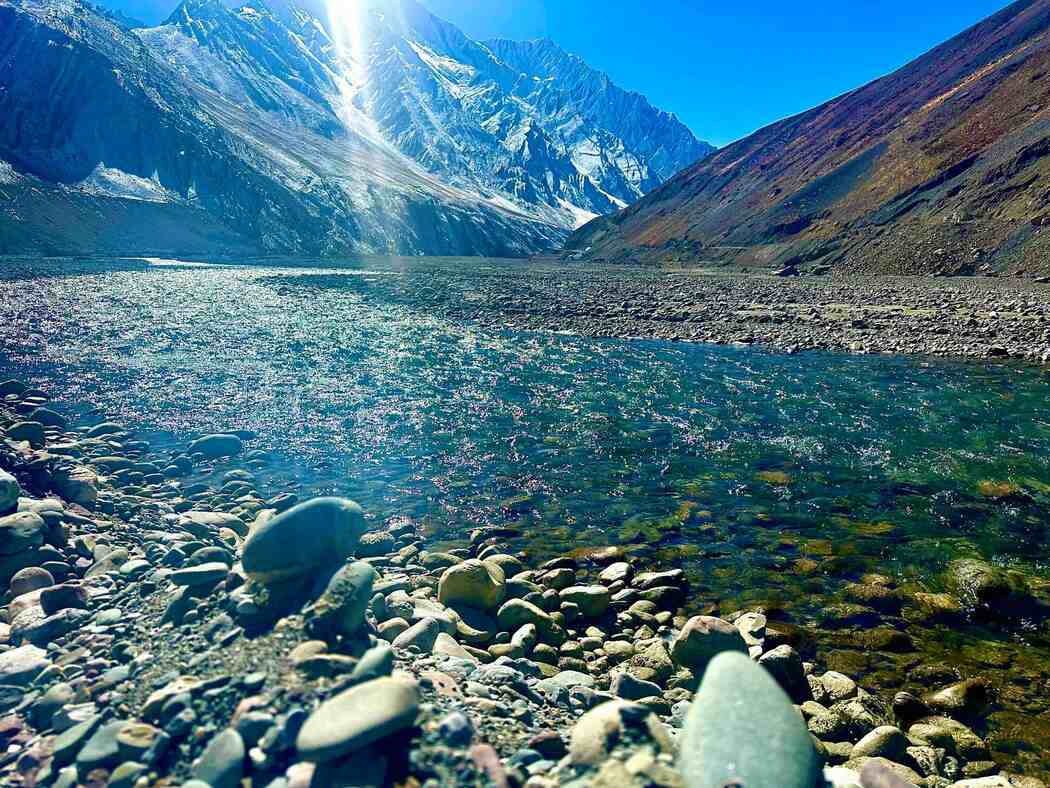
The Pin River rushing over rocks and pebbles, surrounded by towering Himalayan peaks
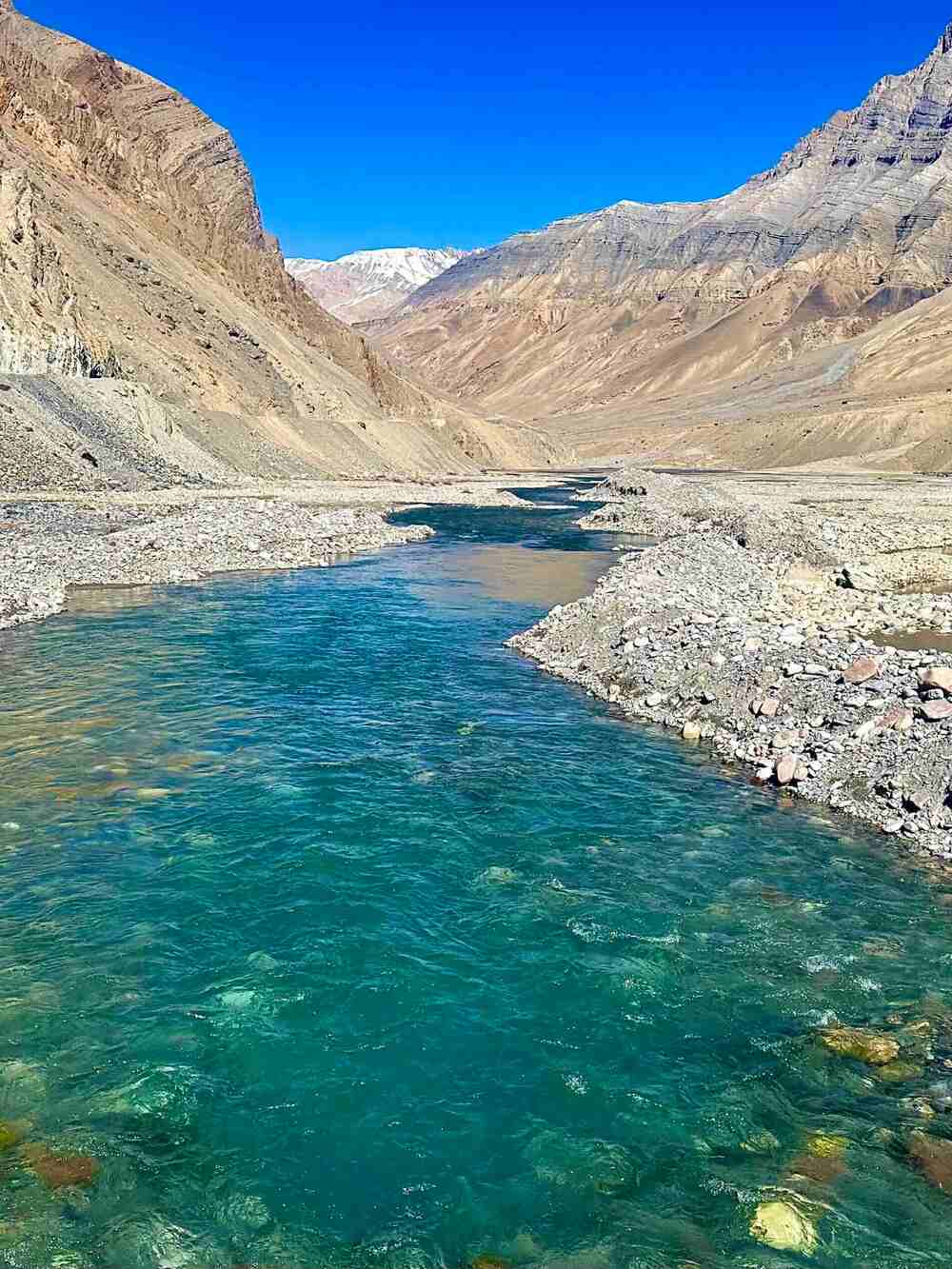
Looking upstream along the braided course of the Pin River valley