
Writing Is Not Intelligence

Writing is a system of communication. It is not intelligence, and it is not a sign of intelligence.
Last weekend I met three parents of teenage children who spoke about the need for young people to write so that they could develop their thinking abilities. It was a session on artificial intelligence and they were concerned about AI in general and in education in particular. One of them presented on AI, a coherent viewpoint except for the assertion about writing and then relating to anecdotal reasons, references to scientific studies but without presenting evidence. The other two parents spoke to me on the sidelines after the event. They were all concerned about the impact of AI and desired firm direction over what their teens should or should not do with AI and felt that children should write more to sharpen the brain, to prevent dementia, to improve reasoning. The teens were present and squirming.
Most adults don't understand Artificial Intelligence. Many are using AI tools but not at enough depth to ascertain what the tool does, how, impact on their work and consequences (if any) on their own abilities. Which is why they reach for whatever feels like scientific wisdom to support their opinions — for or against AI.
Writing is a good example. People who never wrote regularly in their own lives are now insisting that children must write. They always add how they are benefitting, now, from writing. The argument is presented as settled, backed by scientific studies, ringed with authority.
It isn't.
With respect to thinking abilities, I could actually argue the opposite. I find that the more people are formally educated and tutored, the less they are able to exercise independent thinking and judgment. They are more likely to propagate propaganda coming from formal sources, just as religious and politically indoctrinated individuals evangelise moral and ideological viewpoints without scrutinising them.
With respect to dementia and writing: Gabriel Garcia Marquez started writing very early, during school, continued writing throughout his teens, 20s, 30s. He is famous, celebrated, with a huge body of work. He suffered from dementia in the last years of his life. As did Iris Murdoch, one of the greatest and most prolific writers. There are other writers who developed dementia. Linking writing to reduced dementia is a lazy argument because if you want to make a scientific case, one has to examine the case from various perspectives and with rigour. One should not cherry-pick studies that confirm what they want to promote and present them as settled science. A scientific study is done within boundaries, with a purpose and evidence is presented to support or to the contrary. In short, studies have an inbuilt rigour. Evangelists cherry-pick sections that work for their argument often with good intent. The regular reader reacts to the argument if it resonates with their fears or beliefs and they propagate that.
As a person who has been writing since the age of 11, I have a great appreciation of the cognitive and psychological benefits of writing in self-development and well-being (among other benefits); however, I also have empirical experience in training people, designing material for training, and working hands-on on the job floors and I did not find any evidence that people who did not write or did not write regularly are in any way less intelligent or less alert or have diminished memory in comparison to me or others who wrote. I know a lot of people who are forgetting things in their 30s, 40s, 50s but that could also be attributed to not paying attention, always being on social media, reduced attention spans, being physically present but mentally absent, stress and/or anxiety, heart conditions, medications …
Writing became mainstream 75 years ago. Mainstream means when the majority of a population starts using a technology. In 1950, global literacy crossed 50% which is when reading and writing went mainstream. I infer this from the 1957 World Illiteracy at Mid-Century statistical study published by UNESCO. You can see from Table 2 — Page 15 of the report, which can be found at unesdoc.unesco.org — that the World Total row shows per cent of adult illiteracy to be 43–45% in 1950. Flipping that, we infer that in 1950, more than 50% of the global adult population could read and write. That is what I call mainstream. Simple majority of population.
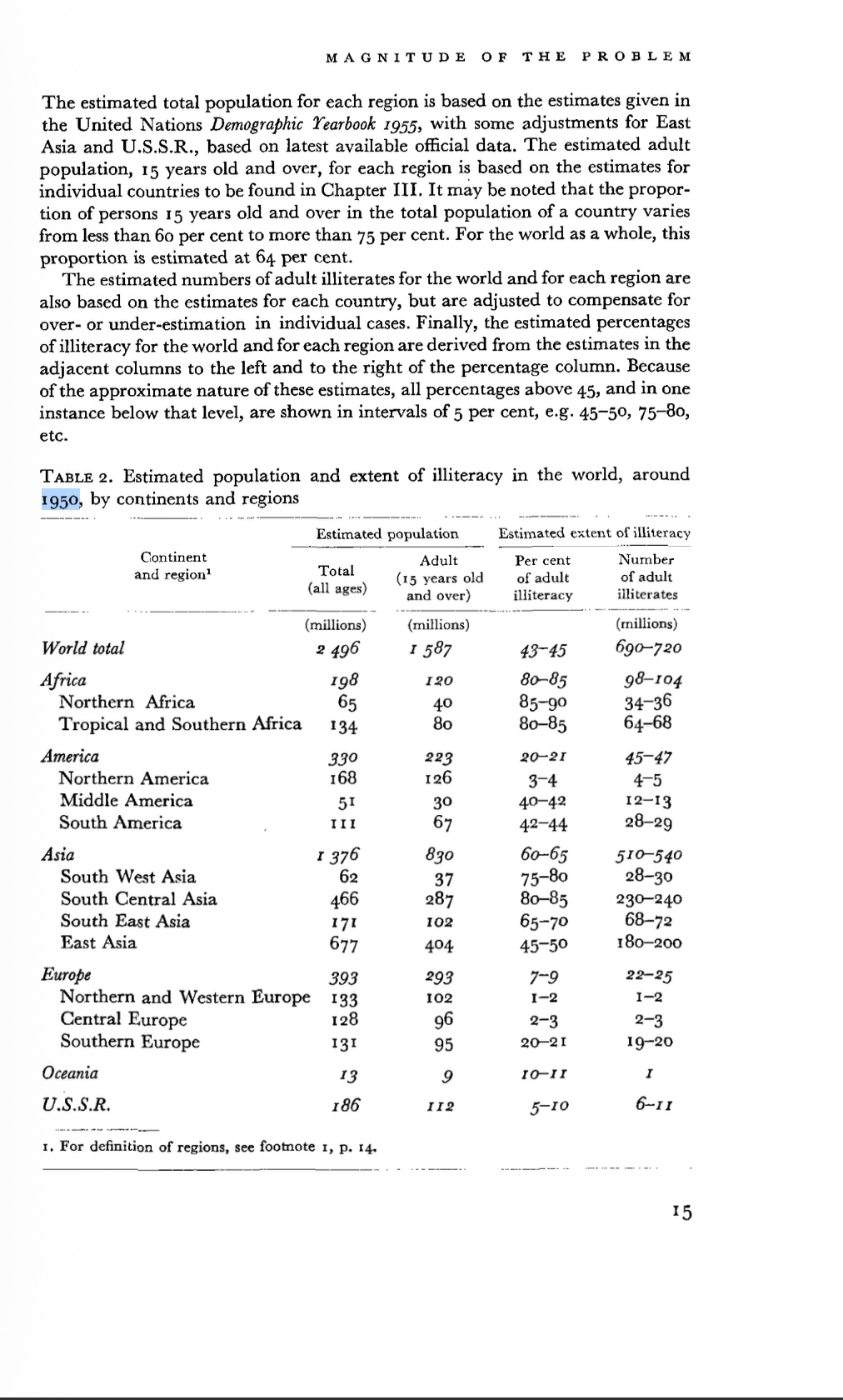
UNESCO, World Illiteracy at Mid-Century (1957), Table 2, Page 15. World Total adult illiteracy: 43–45%. Source: unesdoc.unesco.org
The 1957 definition of literacy: the ability to read and write, with understanding, a short, simple sentence about one's everyday life.
Many nations crossed the mainstream mark earlier. The table below documents when each crossed 50%, the source, and the primary driver.
| Nation | Crossed 50% | Primary Source | Driver |
|---|---|---|---|
| Netherlands | Seventeenth century | Buringh and Van Zanden (2009), Journal of Economic History, Vol. 69 | Commerce, Calvinism, book trade |
| Japan | Late Edo period, pre-1868 | Historical estimates of the Edo period. Note: no national census before 1920; figure derives from historical scholarship | Terakoya community temple schools; samurai class near-universal literacy |
| Prussia | Well before 1850; 84% by 1871 | Prussian Population Census 1871, Die Gemeinden und Gutsbezirke des Preussischen Staates, ifo Prussian Economic History Database | Compulsory Protestant schooling from early nineteenth century |
| England | By 1839–40, already past mainstream at first measurement | First Annual Report of the Registrar-General (1839) | Industrial and administrative need; empire managing literacy as a resource |
| France | 1860s–1870s; ~70% by 1872 census | Furet and Ozouf, Lire et écrire (1977) | Mass schooling policy; linguistic unification of the nation |
| USA | By 1870; 80% overall | US National Center for Education Statistics, 1870 decennial census | Post-Civil War expansion of public schooling. Note: 80% of the Black population remained illiterate in 1870 — one of the starkest literacy gaps in recorded history |
| Italy | 1901; 52% | Cipolla (1969), cited in Basile, Ciccarelli and Groote | Post-unification national schooling policy, deeply uneven between north and south |
| Portugal | Between 1930 and 1940 | Portuguese national census 1940, Statistics Portugal/INE | Salazar regime education reform; first time in Portuguese history majority could read and write |
| Global | 1950; 55–57% | UNESCO, World Illiteracy at Mid-Century (1957) | Post-war global mass education expansion |
The reasons nations drove literacy varied. Prussia did it through compulsory Protestant schooling before it industrialised. The Netherlands did it through the commercial demands of a trading economy in which even ordinary dock workers, guild members and artisans needed to read contracts and ledgers to avoid being cheated and to participate at all. For the poor and underprivileged everywhere, that was the real trigger — not fame, not intellectual prowess, not dementia prevention. The ability to sign your name in the marriage register. The ability to sign a contract. The ability to read the terms of employment. The ability to move from unskilled labourer to skilled tradesman. Economic participation, for those at the bottom, has always meant the ability to transact on slightly less unequal terms. That is the ladder. Literacy was a rung on it.
Since the Industrial Revolution in England — 1760s onwards — and its spread through Europe and then the United States, empires and governments systematically adopted mass education policies for one reason above all others: they needed literate classes to do jobs that required reading and writing. Education — until then strictly guarded and reserved for the rich and privileged — was taken to the masses because industry required it. Writing instruments became cheap. The steam-powered printing press arrived.
And here is where it becomes instructive: Every new technology of communication does not simply replace the previous one. It spawns its own processes, its own knowledge systems, its own industries, its own mythologies. The printing press spawned publishing and early trade correspondence. Trade correspondence and commercial intelligence networks spawned the newsletter and the gazette — merchants in Antwerp, Venice and Amsterdam were circulating handwritten commercial news sheets in the late sixteenth century, before most of Europe could read. Cheaper print and rising literacy then spawned the reading public. The reading public and the newspaper arrived together and fed each other — mass journalism and popular serialised fiction grew simultaneously, each creating demand for the other, each requiring and accelerating literacy to function. Serialised fiction also gave birth to a new kind of popular celebrity. Each layer added processes and knowledge systems that were then mistaken for intelligence itself rather than recognised as adaptations to a new communication medium.
The mechanics are worth examining because they are precise. Charles Knight's The Penny Magazine, launched in England in 1832, sold for one penny and reached a circulation of more than 20,000 copies within its first year. It was explicitly designed to educate and improve the poor. In 1836 the English stamp tax on newspapers was reduced from four pence to one penny. Circulation of English newspapers rose from 39 million to 122 million copies by 1854. By 1833 Benjamin Day had launched the New York Sun as the first penny newspaper in America — within three years its circulation exceeded that of eleven of its six-cent competitors combined. Readers had become the product being sold to advertisers. A new revenue logic had been invented that depended on mass literacy to function.
Charles Dickens was not incidental to this. When Dickens began writing in 1836, literacy in England was under 50%. His serialised novels — published in monthly instalments at a shilling each, later in penny weekly parts — were deliberately priced and formatted to reach people who could not afford a bound volume. Illiterate members of the poor would gather to have each new episode read aloud to them — as Jeremy Hawthorn documents in Studying the Novel (1985), and Philip Collins records that Dickens's own mother-in-law's charwoman attended a monthly tea subscription specifically to hear the latest instalment read aloud. The Pickwick Papers, his first serial, went from a first print run of 1,000 copies to 100 times that for the final instalment. Dickens was simultaneously creating readers and creating the demand for more literacy. He was also, not coincidentally, the most popular author in working-class communities for decades — literacy spread partly because people desperately wanted to read what he had written next.
The education industry and the publishing industry had aligned commercial interests in the same outcome. Publishers needed readers. Schools needed pupils. Both sold literacy as aspiration — as the route to knowledge, to respectability, to a better life. The fantasies of intellectual prowess and writerly fame were the marketing layer on top of the actual economic driver. They were not false. They were just not the reason literacy spread. The reason literacy spread was that the industrial economy required it, the publishing economy profited from it, and the poor needed it to transact.
So did intelligence not exist before writing went to mass scale? Did people decay and die of dementia because they could not read and write? Was nothing invented, created, or understood before literacy was defined in the throes of the Industrial Revolution and redefined in the aftermath of the World Wars, Computer Ages, and so on?
These are questions for another day.
Writing is very important, but it is a system of communication based on linguistic symbolism and assignment of meanings to those symbols. Writing is neither intelligence nor a sign of intelligence. It is a method to record the output of an intelligence. Just as musical notations are not music but a way to communicate how a musical composition sounds. A communication system creates its own processes and related knowledge systems. These additional processes and functional knowledge systems do not constitute intelligence, though they may be useful to see whether an individual can adapt to a new way of communication.
Proficiency in writing — which is extremely rare even among literates — is a measure of how well you have learned to write. Mastery is much rarer. It is the rarest of rare individuals who have mastered writing to such an extent that their writing can reflect intelligence directly, but even in those cases, it is still an output of intelligence and not intelligence itself.
Children can benefit from writing. But they are more likely to write if schools let them write what they want rather than tell them what they should write and how.
I see it as a sign of high intelligence when children refuse to write in their own words on subjects that have less than no interest to them. It is incredibly smart of them to use AI to submit required work that has no meaning in their lives. They are ticking the box and conserving time for friends and what has meaning for them.
That is real intelligence.
Copyright 2026 Sanjay Mahendrakumar Mukherjee