
What We Get Wrong About Archaeology
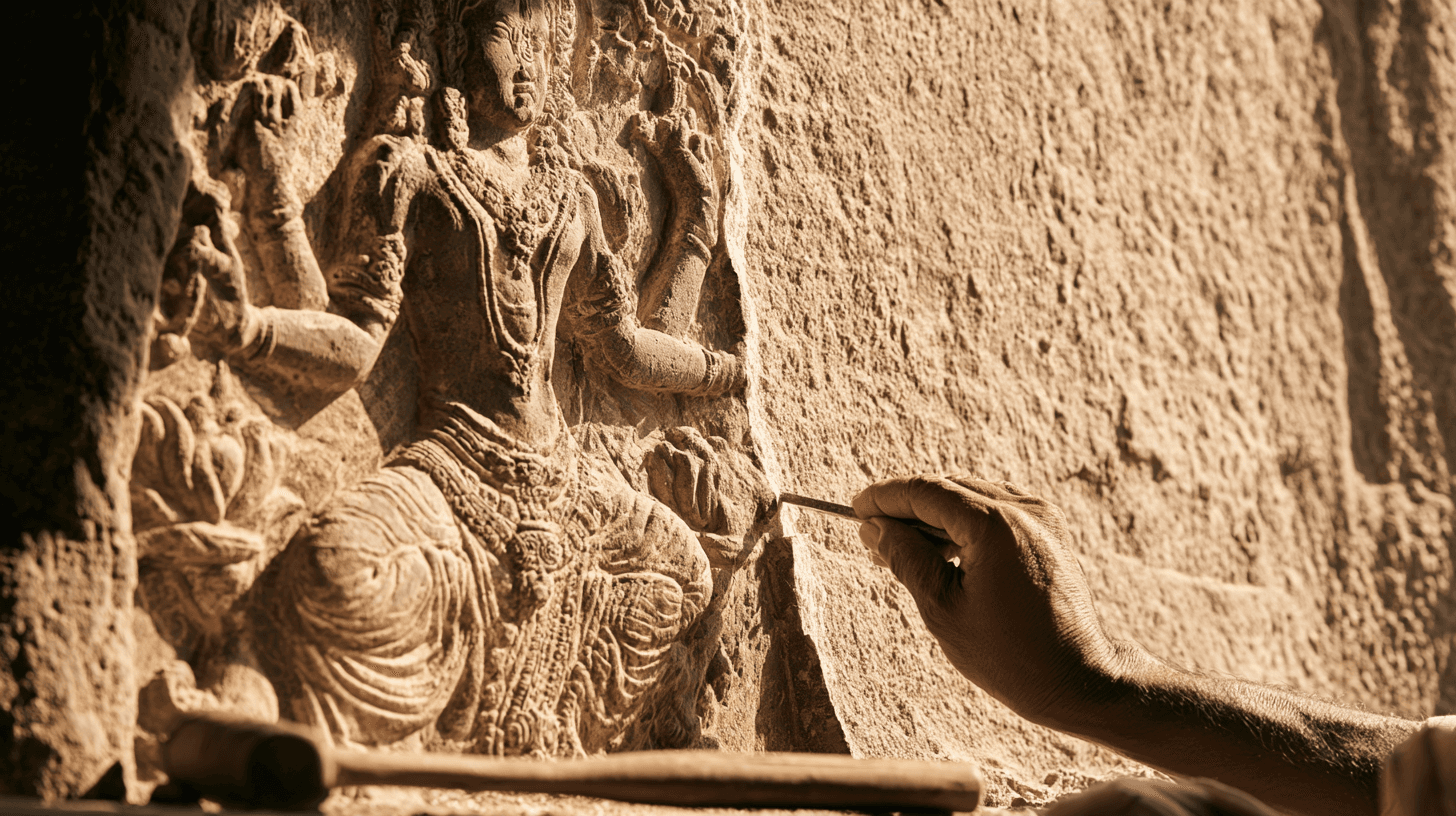
A relief carving in progress — the same patient, hand-by-hand craft the piece describes.
Anindya Sanyal, 19 September 2026
Say the word 'archaeology' and most people picture someone in a pit, brushing dust off a skull. But really, archaeology is a study of humans: how people learned to build, to shape clay, to carve mountains into temples. It's less about death and far more about how humans quietly kept getting better at being human.
Nowhere is that clearer than in India, where the story runs unbroken for thousands of years.
Times around 3300 BCE saw the early architecture of planned cities; by 2500–2000 BCE, this had grown into mortared roads, the Great Bath, and granaries at Harappa and Mohenjo-daro. Picture a family in one of these cities — walking on baked-brick streets, water running out through covered drains beneath their feet, grain stored safely in communal granaries built to careful proportion. No metal tools to speak of, no wheel-driven machines, and yet the planning is startlingly precise. At Lothal, in Gujarat, there's even what looks like a dockyard — meaning someone, long before written history in this land, was already thinking about tides, timing, and trade.
About a millennium apart, instinct to refine the crafts gets sharper. By 700 BCE, potters along the Ganga plains are producing something remarkable: Northern Black Polished Ware, pottery with a deep, almost metallic black sheen — so fine that no one today can say for certain exactly what the polish was made of. Around the same fires, iron was coming into wider use, forests were turning into farmland, and new towns like Kaushambi and Rajgir were rising. A pot, in this light, stops being just a pot — it becomes a signature of a whole trading, farming, city-building world.
Centuries later, the ambition shifts from clay to stone — and grows enormously. In the 8th century, Rashtrakuta craftsmen at Ellora didn't build a temple upward, they carve one downward, out of a single hill of basalt — chiselling away tonnes of rock by hand to leave the Kailasa temple standing where a mountain once was.
By the 10th–11th century CE, the Cholas take that same patience even further south. Rajaraja I's temple at Thanjavur rises over 60 metres, topped by a single 80-tonne granite block, said to have been dragged up a ramp built specially for the task. In their workshops, the Cholas are also perfecting lost-wax bronze casting — pouring molten metal into wax moulds to create the dancing Nataraja, a figure so alive in motion it barely looks cast at all.
No engines, no electricity, across all these centuries — just people, watching, testing, failing, and trying again. That patient accumulation of skill, passed hand to hand across generations, is really what archaeology is trying to recover.
(Anindya is a Doctoral Researcher in Archaeology at the Banaras Hindu University, Varanasi. He has a Master of Arts degree in Ancient Indian History, Culture, and Archaeology, and works on field projects in rock art, human-faunal interactions, and ethnography.)