
Can three chefs run the central kitchen of a 5-star hotel with one trainee?
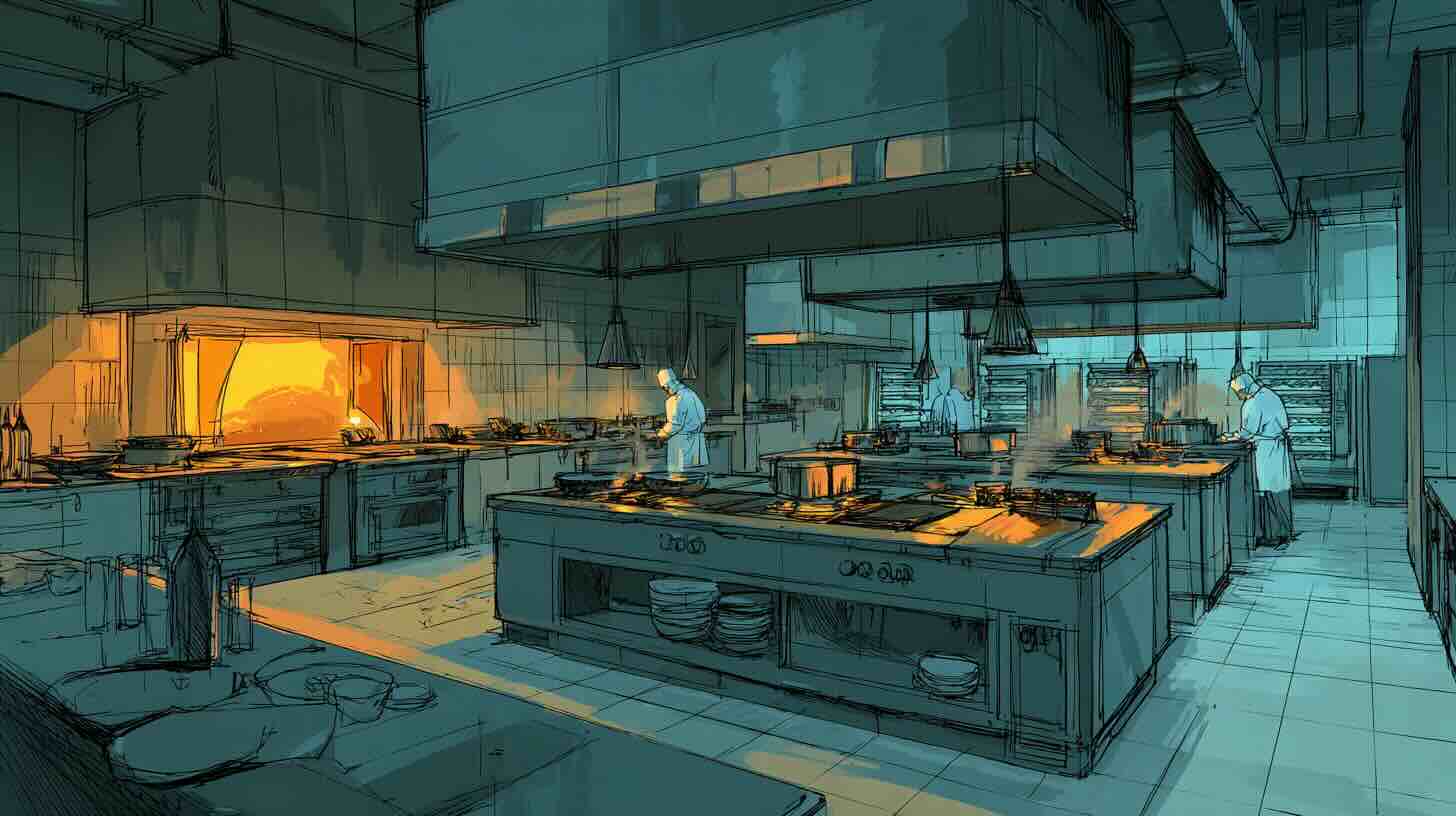
Four kitchens. Four people. A Tuesday lunch crowd that appeared out of nowhere.
One fine morning in early 1991, I found myself reporting to Ramesh Borwankar, a Chef de Partie (CDP) in the central kitchen of the 5 star hotel, Centaur near Santacruz Airport, Mumbai. The central kitchen comprised the Indian section (including tandoor), Continental range, Pantry, and the Bakery. The hotel also had a speciality Chinese restaurant, an Italian restaurant with their own Chef and kitchen staff, but the coffee shop, room service and banquet were typically handled by the central kitchen.
Ramesh was in charge of the continental kitchen at the time. I had already met him since I had been working as a waiter in the coffee shop the previous two weeks and I used to interact a lot with him to pick up orders that I served.
One of my first conversations with him went something like this (our conversations were always in Marathi, Mumbai Hindi and English — this is a verbatim translation, no approximations):
"You are middle class."
"Yes, I am!" I remember breaking into a big smile.
He had sighed. "You won't last long in this industry. It will chew you up."
"Why, why, why?!" I had been very perplexed.
"You are respectful, even for middle class kids. Polite is fine, it is superficial and protects you. Respectful is a problem since there is sincerity and this is an industry of make-believe, like the film world."
Very few people — and none of my batch-mates who were also interns at the time — knew that Ramesh had a Masters in English Literature, apart from having graduated from the same prestigious institute of hotel management that we were then attending.
On the very day I joined the kitchen, the hotel's unions called a strike. I remember it because my shift started at 8 am and at noon, everyone disappeared, that was usually when the break-shift staff always came in. There were four people left to run four kitchens — the Sous Chef took over the Indian, Ramesh the Continental of course, bakery chef did his own thing, and I, a novice trainee, was appointed to the pantry.
The CDPs and the Sous Chef were essentially not part of the union and had executive responsibility. The speciality restaurants were also out of the ambit of the strike.
As usually happens, immediately after the strike was announced, orders started pouring in — a Tuesday lunch crowd appeared out of nowhere. Tuesdays were traditionally lean days. Before I realised it, I had three KOTs in front of me. A KOT is a Kitchen Order Ticket. It used to be made by the captain or manager of a restaurant on a KOT book, in triplicate. The waiter took the top copy to the kitchen, the second went to the cashier, the third one stayed in the book.
I was excited when I received the first one. It was an order for a plain Chicken Sandwich and an Orange juice. My mind went to the plated sandwiches I had seen when I was working in the coffee shop — sandwich, coleslaw, cucumber, tomato, French fries. Where were the plates? I started looking around, and then another waiter came in, smiled at me and handed me a KOT and left. It had another Chicken Sandwich, a cold coffee, and an order of toast. I had already forgotten about the first order and then the third came in: 2 Chicken Club Sandwiches, 1 order of fries, 2 orange juices, an omelette and toast with coffee. Three minutes had passed, I was just standing there looking at a fourth KOT coming the kitchen way, and I was relieved when the waiter delivered it to the Conti kitchen. My mind was blank.
Then Ramesh's voice cut through sharp as a cleaver through meat.
"Never be in a hurry in life. You will always end up late. What's the first order?"
"Plain Chicken Sandwich Chef!" I responded immediately.
"Three slices of bread on the chopping board section."
"Done chef!"
"Steel bowl, two ladles of boiled chicken, 2 scoops of mayonnaise, salt, pepper, mix."
My hands moved in a flurry, following a few seconds behind his commands. "Done chef!"
"Butter the top of first slice, butter the top of second slice, butter the inside of the top slice."
"Yes chef!"
"Trim two lettuce leaves, place one each on first and second slices. Plop a ladle of mayo chicken on first slice, then second slice."
"Done chef!"
"Spread evenly. Place second slice on first slice, close with top slice."
"Done chef!"
"Serrated bread knife, first drawer, right hand side. Cut the crust in one clean motion on every side! No brown edge should be visible! Don't lose your focus till the very end. You can make a great sandwich and then cut too much or too little of the crumb. You will have to start over again — we don't send bad quality or badly presented food. Our guests come here to feel valued and relaxed."
By now muscle memory was very much in place. I heard his instructions clearly, and saw myself plating the sandwich, plating coleslaw, cucumber slice, tomato slice, and scooping a portion of French fries on to the plate.
"Place on delivery counter, punch KOT. Laey bhaari!" — Excellent, in Marathi. "Second order?"
The Conti kitchen was next to the pantry, and beyond that was the Indian. Both the Sous Chef and Ramesh had been watching me. Since Ramesh was next to me, he took charge.
In the next hour I learned the most important lesson in my life about leadership and its direct relationship to performance. And over the next 72 hours, I learnt that and other simpler lessons over and over again.
Around 4 in the evening, we got a breather for 15 minutes. They tried my sandwiches and in 5 minutes taught me the preparation drill for the pantry. Five minutes. Simple stuff: inventory, order or make what has to be replenished, study the quantities each day, predict the volume, and make or order 10% more. Check inventory every three hours, but specially after a rush. Know your work time for every dish — grills take longer than omelettes, juices always fresh made.
"If you make a mistake, it's okay. Don't waste time worrying, start over immediately. Always the right decision."
The strike lasted four days. I went home only once during that time. I showered in the hotel, caught cat naps like Ramesh and the Sous Chef. We never ate alone. Always together, and the same food. If an order came while we were eating, all of us got up and delivered and then resumed the meal.
By midnight on the first day, I was running the pantry on my own — drilled to perfection by either chef as available. They were very different in approach but the method was same: command voice, no ambiguity, execution path was crystal clear. They themselves were running the entire sections on their own. It is a beautiful thing to watch masters at work, cut chop, sauté, stir, dish, plate, garnish, dish after dish after dish, no break in rhythm, clockwork. The Conti kitchen was usually manned by three cooks and Ramesh. The Indian kitchen had four and the Sous Chef was never actually on the floor since his responsibilities were administrative and planning and procurement.
From the second day onwards, I started manning the tandoor during lunch since pantry orders are fewer at lunch and helping with sauces and sizzlers at dinner. I had figured out the pantry drill thanks to a very simple guidance: "If you are alone or short-handed, let the restaurant know what you can deliver and what is off the menu. But if you prep well, you can deliver it all. Take pride in that challenge — it is exciting. Always let the waiter know if you are going to take longer, apologise, and smile. Keep the environment fresh, like the food."
By the time the strike ended, I was a part of the kitchen. And it seems I had passed Ramesh's favourite test: "Write your name in the list of people who want to improve. Whether you improve or not is a later matter. But start by intending to improve."
I spent 3 weeks in the central kitchen, a week in each of the speciality kitchens and the bakery. Thanks to their recommendations, I was given responsibilities, and the autonomy to take decisions in every department I went, being in the thick of things, treated as part of the team — given hard feedback for errors and terse nods for doing my job. My internship became performance support, all because two chefs led from the front and carried me through every situation. They also followed up and made sure my training report highlighted my work during the hotel's crisis.
The most important lesson they taught me: Keep calm.
That is what leadership looks like to me.
Yes it is possible for three professional chefs to run the central kitchen of a 5-star hotel.