
The Stamp Book
The first Sunday of the month.
The list starts a week before the list is needed.
It lives on the back of an old envelope, on the shelf by the phone, and it grows by accretion — my mother adds a thing when she notices a thing, and by Thursday there are items in three different pens and one in my sister's handwriting, which is Bournvita, written hopefully and underlined.
Then the dabbas come down. Every one of them is emptied, the last inch tipped into a cup, wiped out, held up to the light, dried. By Saturday night the kitchen shelf is a row of clean empty steel, and the flat feels briefly like a place nobody lives in.
Sunday is the day.
Apna Bazaar has three floors and we almost never leave the first one. Groceries have their own weather — you walk in and it's dal and jute and soap all at once, and then you turn into the next aisle and it changes completely, spices sharp enough to make your nose consider sneezing, and then the detergent row, which smells blue. Somewhere past that, biscuits. I could find that aisle blindfolded.
The list is torn into strips and distributed. This is the part I wait for. I get four items and an aisle, and I go off with my strip of envelope like a person with a job, checking the weight on the packet against what's written, because getting the half-kilo when the list says one kilo is the sort of thing that gets discussed at home for a week.
Twice a year we are allowed upstairs. Appliances before Diwali, which is mostly my father and a salesman talking about a mixer. Clothes at the start of the school year, which is where the mannequins are — pale, headless, standing very straight in outfits I will not be getting, and I look at them for longer than I need to and then follow everyone back down.
The billing queue is a mood reading of the whole city. First Sunday of the month, it's long. First Sunday before Diwali, it's a story you tell later. The clerk wets his thumb, writes it all by hand, tears off the carbon copy, and hands over the stamps with the change.
At home we have tea first. That's the rule. Then the bags come out.
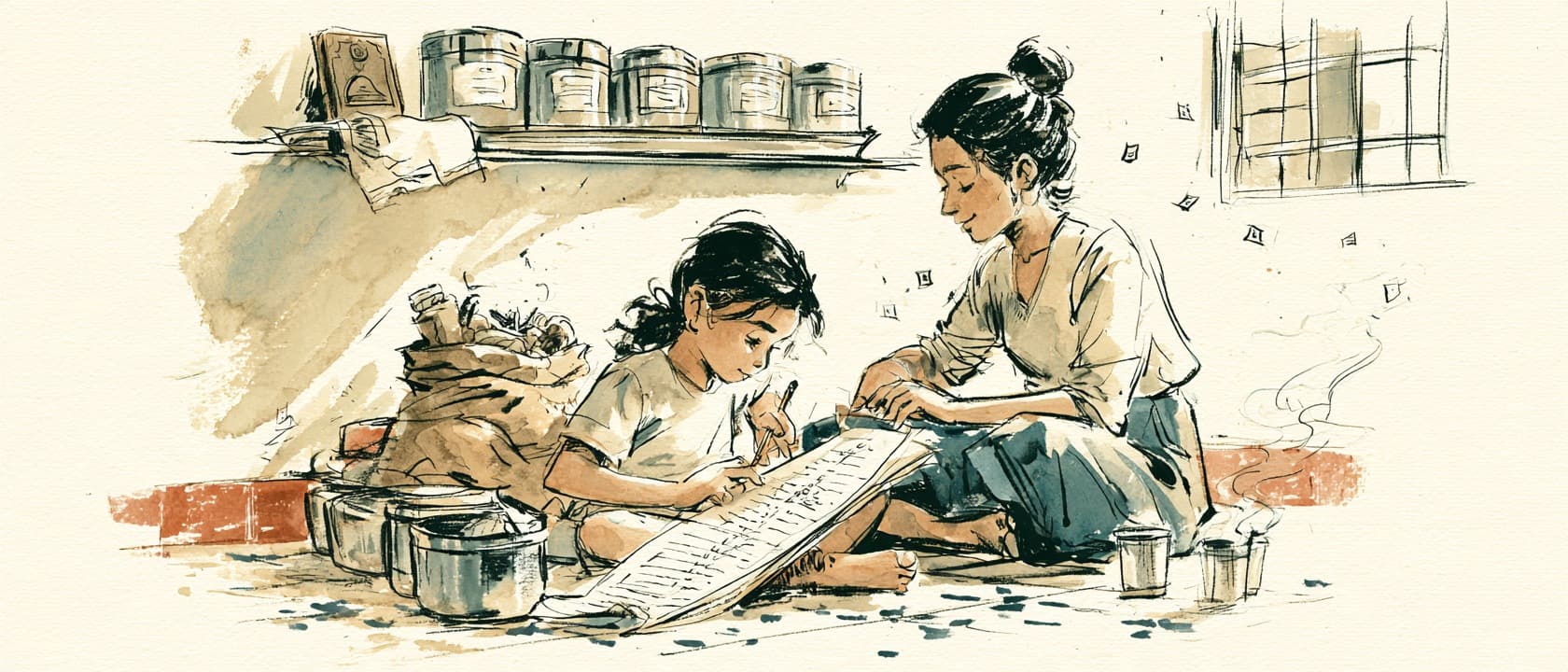
My mother calls out the items one by one with the price — sugar, five kilo — and I sit cross-legged on the floor with the bill, finding the line, drawing a tick beside it. Every single item. All the way to the bottom, where I add up whether the total is the total. I am nine, and my job is to catch the shop being wrong, and once in about eleven months the shop is wrong, and the feeling of finding it is better than anything else that happens to me that month.
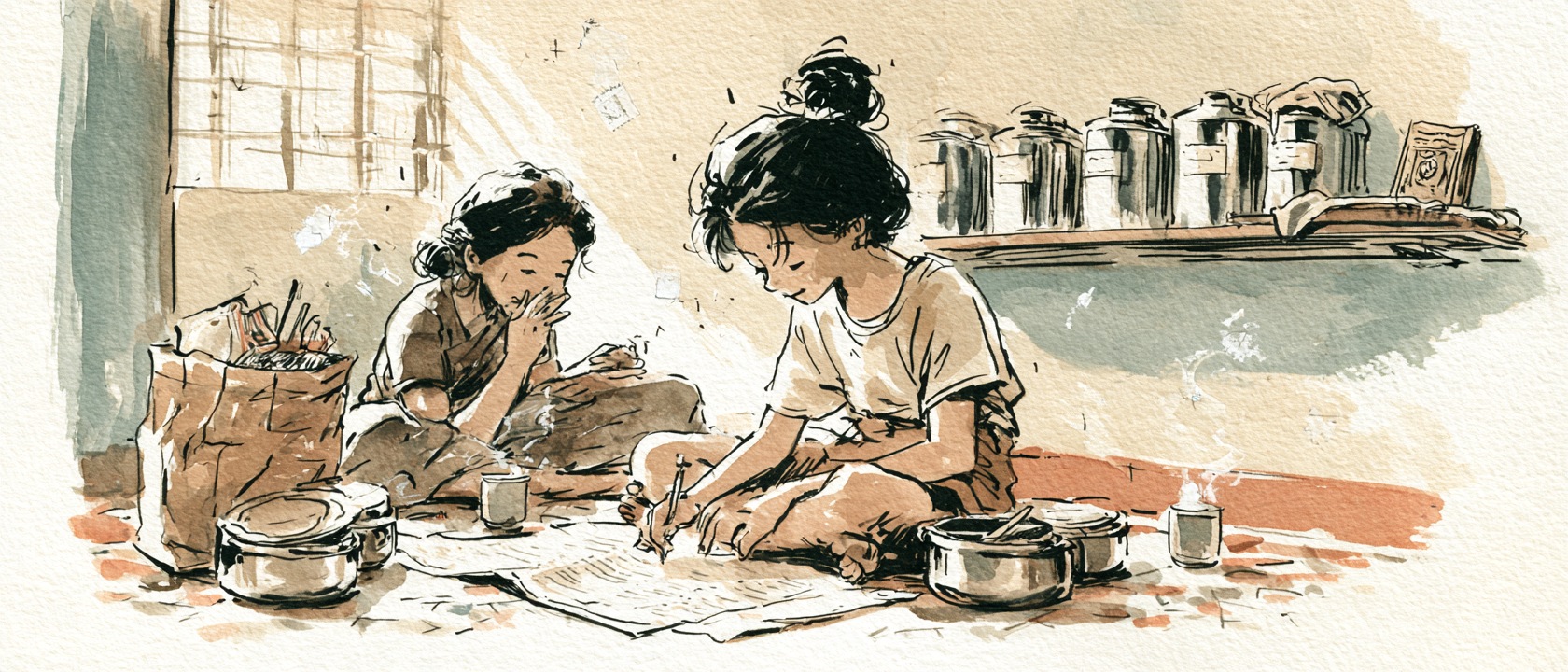
Then the dabbas go back up, full, labels facing out, heaviest at the back. And last, the stamp book — the stamps licked and pressed in, row by row, the page filling by the month toward whatever we are saving them for. The book is wiped with a cloth and put back in the drawer.
Everything comes in ten minutes now, in a paper bag, from an app that also tells me what I usually buy and is not wrong about it. The bill arrives before the order does. If something's missing, the money comes back on its own, and I never look.
So the dabbas in my kitchen are never empty and never full. Nothing runs out, so nothing gets stocked, and the month has lost its shape.
And nobody has handed me a bill in thirty years and trusted me to find the mistake.
Editor's Note: The author conceived this article from her lived experiences and drafted it with assistance from Claude, using her own inputs and reflections. The illustrations were generated with Midjourney.
(Kanchan Shine is a daydreamer with a notebook. She reads more than is sensible, watches people slightly longer than is polite, and has never lost the habit of asking how a thing works — or when it quietly stopped working that way. She's an author and former entrepreneur, now serving as Chief Learning and Innovation Officer for Hurix Digital, where her weekdays go to learning design and artificial intelligence. She's also the author of Sticky Learning: From A to Z. Here, she's off duty — writing about whatever she's noticing at the moment.)