
The Red Ribbon
Sunday, a little before nine am.
We are on the floor in front of the television with breakfast, and the milk, and the exact tension of people waiting for one specific sound.
Spider-Man, Spider-Man…
Then the picture pulls sideways. Two lines cross the screen, the sound goes thin, and the whole thing dissolves into snow.
We sigh in unison and turn our heads to look at my father, who is reading the paper and who knew this was coming from the moment the first line appeared.
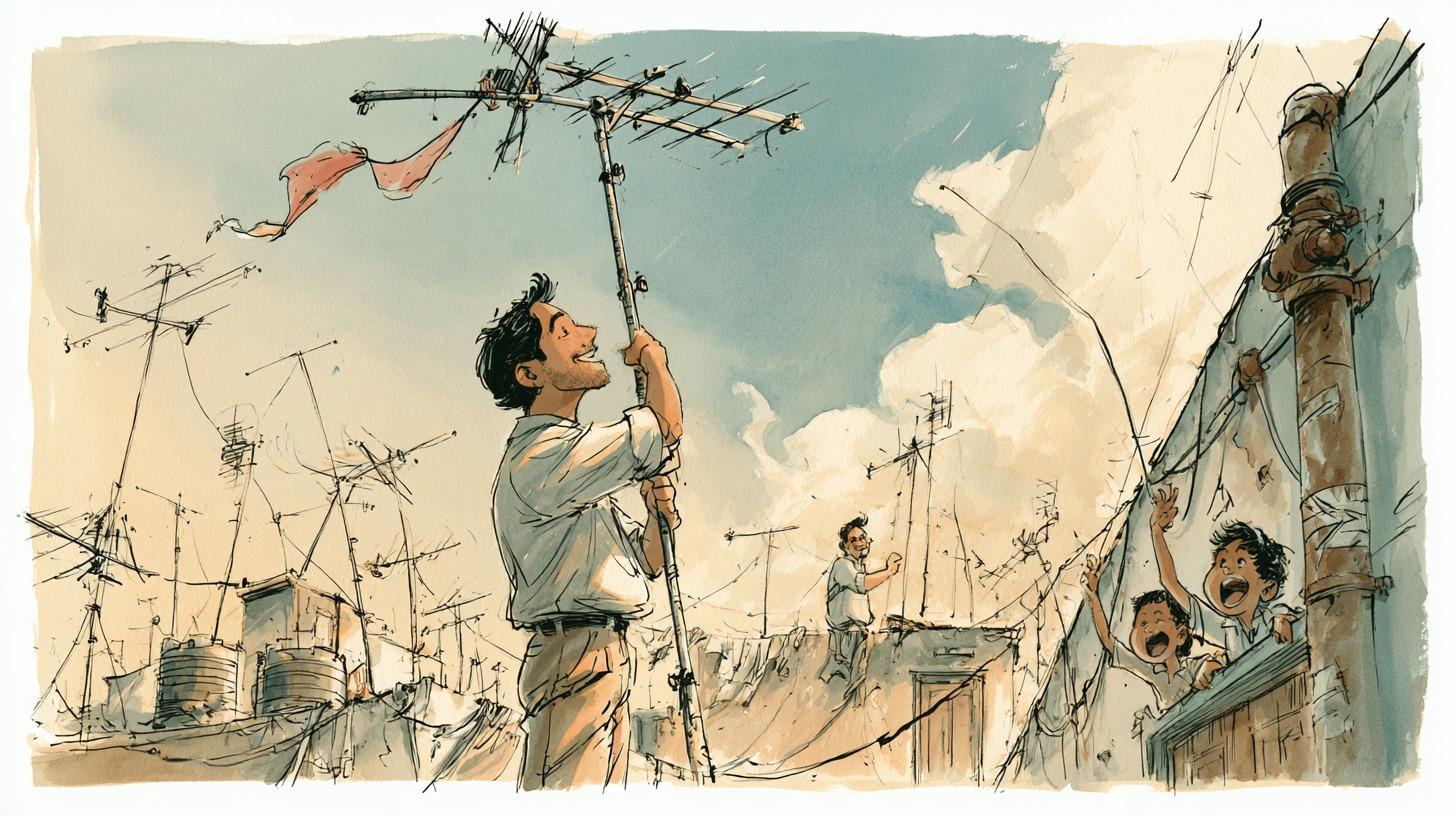
He puts the paper down. He does not hurry, which at that moment is nearly unbearable. Lift to the seventh, then the stairs to the terrace, where there is a whole forest of aluminium up there — every flat's antenna, staked out in a crowd, wires running down the outside of the building and taped along the drainpipe like a system nobody ever designed.
Ours is the one with the red ribbon. My mother tied it there years ago, and it has faded to pink and frayed at the end, and it is the only reason we don't spend twenty minutes turning somebody else's picture.
My sister is at the television. I am at the window, half out of it, neck back, and the relay begins.
Not yet!
He moves it a few degrees. On the screen the snow thins into something almost like a picture and then gives up.
Little more — no, back — BACK—
He goes back. Two lines. One line.
Yes! Yes yes yes — hold it! HOLD IT!
And there it is, locked, sharp, the red and blue of him swinging between buildings, the song already halfway through, and my sister is screaming that it's on and I'm screaming up that it's on and somewhere on the terrace a man in his Sunday clothes is standing with one hand on a pole, holding it still for a second longer than necessary, just to be sure.
He tapes it at that angle, usually. It holds until the next big wind, which in July is Tuesday.
By the time he comes back down the episode is going and all three of us are absorbed in it, and nobody looks up, and nobody says thank you. He picks up his paper. Between the wind, the monsoon, and whatever the building did to itself, he went up to that terrace perhaps forty times a year, and I am fairly sure he never once saw the opening of anything.
Every so often there'd be somebody else already up there, hands on their own pole, mid-negotiation with their own family five floors down, and the two of them would nod at each other. A whole Sunday economy of men on terraces, correcting the sky by a few degrees for children who were shouting at them from windows.
The picture is perfect now. It is perfect at four in the morning, in the rain, in a moving car. It is so perfect that the only thing left to go wrong is the wheel — the little circle that turns and turns while nothing happens.
And when that comes, there is nothing to do. Nobody to send. No pole, no ribbon, no angle. You sit and you wait and it fixes itself, or it doesn't, and either way your hands stay in your lap.
I would give a great deal to hang out of that window again and shout not yet, not yet — YES at my father on a terrace two floors above me, who could not see the screen, and who got it right anyway, every single time, because we told him when to stop.
Editor's Note: The illustration was generated with Midjourney.
(Kanchan Shine is a daydreamer with a notebook. She reads more than is sensible, watches people slightly longer than is polite, and has never lost the habit of asking how a thing works — or when it quietly stopped working that way. She's an author and former entrepreneur, now serving as Chief Learning and Innovation Officer for Hurix Digital, where her weekdays go to learning design and artificial intelligence. She's also the author of Sticky Learning: From A to Z. Here, she's off duty — writing about whatever she's noticing at the moment.)