
The Quilt Beneath the Ground
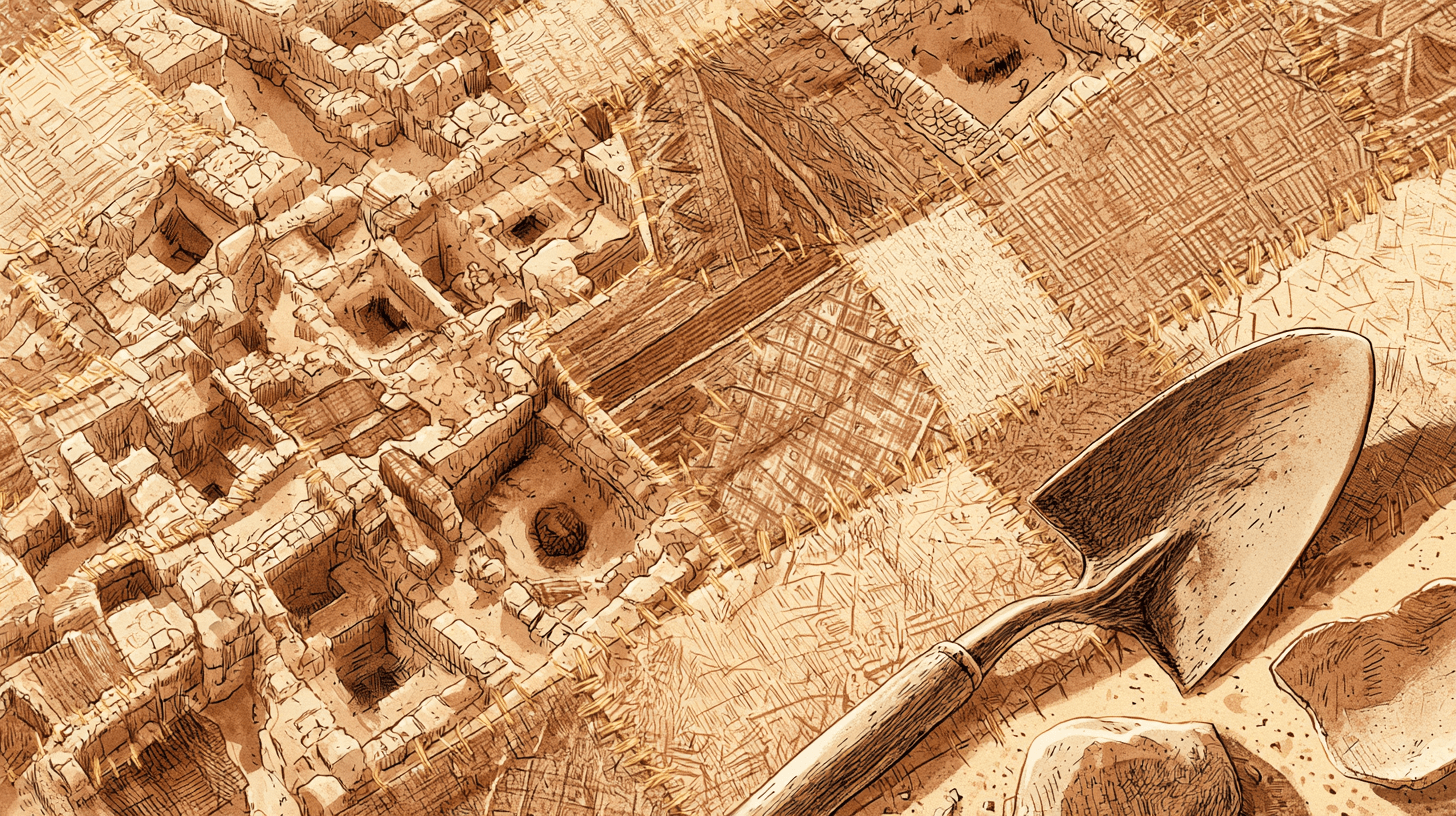
The city as quilt — excavation as the stitching that holds difference together.
Archaeology was, to me, as a child, an entirely different matter, and one of digging up things! Brushing and collecting dust with a little trowel, scraping meticulously at the ground, in search of something old and forgotten — a shard of pottery, a bone, a coin. I would remember that image for years after, with documentaries and museum dioramas giving it reinforcement. I didn't begin working seriously in the field until then when I realized how limited the vision had been. Excavation is only the start of a vast project. In the preliminary steps of archaeological research, I value the larger questions which it evokes: questions of relation to others, of construction of meaning, of its continuity, of its lack of it, across time.
The discipline is much bigger than principles of excavation and its treasures. It includes sculpture, rock-art, painting, murals and many other forms as well. It is such an enormous field that no one individual can cover. But each of these lines is connected to the others, and so in tracking those lines there are new facts discovered, and new stories: old ones and new ones and new stories of old ones.
The initial attraction for me towards an experiential approach to the past was an appreciation that, at the fundamental level, archaeology is a lived subject. It is not factual information that can be acquired from history alone. You must experience it first to fully appreciate it, walk through it and still stand where people have walked before. The thickness of a wall turns into a size of labor and authority. The location of a hearth tells of the nature of family life. The evidence of a trade route gives some indication of what the strangers trusted each other to be. This is not entirely realized on the page, but it is entirely realized in the space when it is experienced by the hands of a person who created the logic of the space regardless of the fact that its origin may rest in the memory of one(s) who developed it decades, or even hundreds, of years ago. This is what makes the altogether special power of the discipline tangible — it can be entered and walked through.
My second shift was when I started to see societies as somewhat like a quilt of custom and behavior. But all societies that I have studied — all societies that I have lived in — every one of these societies is divided: along craft, along ritual, along class, along belief. Artisans imparted technological skills to potters that were secretive. In addition to being different among the various cultures, burial traditions varied among the quarters of a settlement, and from one generation to another. This division may feel like a disassociative cut at certain points in the past, but it is the disassociative parts which are then linked together to create something larger. What was a city, never a one-handed city but a hundred hands, laid over one another and patiently negotiated into a coherence that is enough to enable trade, worship, labor and survival to go forward together. Without a doubt, the most human thing one discovers in archaeology is that such varied practices can be woven together to make a functioning society.
Last but not least, the discipline and the people whom I'm studying make it clear to me that unity is not uniformity. Each civilization studied throughout this endeavor was heterodox, having different practices, tongues, gods, traditions, etc., and lived long enough to bequeath a legacy to future generations. This is a silent protest against the homogeneous society required for survival. What societies need instead is adequate commonality sufficient to enable difference to coexist and intertwine.
It's not because I like the digging that I say I'm interested in archaeology. But the preceding of the being who it has long been as human, who lives in difference and holds it together in complicated fashion, not always without friction, is remarkably intelligent.
Anindya Sanyal is a Doctoral Researcher in Archaeology at the Banaras Hindu University, Varanasi. He has a Master of Arts degree in Ancient Indian History, Culture, and Archaeology, and works on field projects in rock art, human-faunal interactions, and ethnography.