
The Many Shades of Red: Reflections from Kaimur
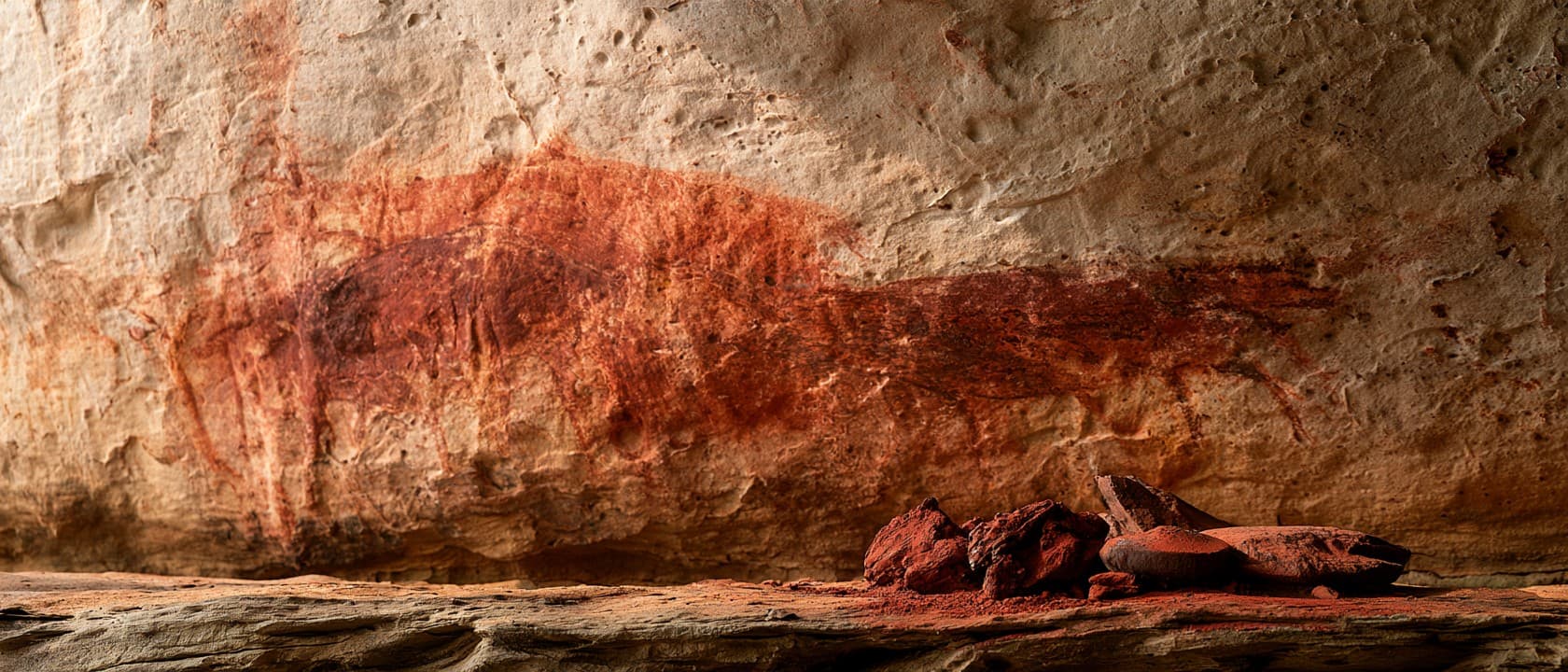
Illustration: red ochre pigment and a painted figure in a rock shelter. AI-generated image.
During my work on pigment analysis of the rock paintings in the Kaimur range of Bihar, I found myself fascinated by something I had perhaps taken for granted earlier: colour. We often stand before prehistoric paintings and marvel at the figures, animals, and stories they preserve. But I began to wonder about a more fundamental question: how did the people who made these paintings prepare their colours, and how much knowledge did that process demand?
Our research focused on the red pigments, generally associated with haematite, an iron-rich mineral commonly used to produce red ochre. Yet, as we examined the material evidence, the story became more interesting. We identified more than 15 different shades of haematite, each revealing a remarkable range of reds and earthy tones. I remember thinking how extraordinary it was that something we casually call red could hold so much variation. It was a reminder that colour, even in its most familiar form, is never quite as simple as it appears.
The experience also encouraged me to look beyond haematite. The possibility that laterite might have been used in preparing pigments opened another avenue of inquiry. Could ancient painters have experimented with different iron-rich earths available in their surroundings? Might the landscape itself have offered them a diverse palette?
Archaeological evidence from other Indian sites makes this possibility even more fascinating. At Bhimbetka, for instance, V. N. Misra reported excavated haematite nodules in more than twenty hues, many bearing facets produced by grinding for pigment. The surviving paintings there display reds ranging from scarlet and pale red to dark chocolate. Such evidence suggests that prehistoric artists possessed a practical understanding of mineral materials long before the emergence of written treatises on art and colour.
What struck me most was the sophistication behind this seemingly ordinary act of painting. Selecting a mineral, processing it, achieving a desired shade, and applying it to an uneven rock surface required observation, experience, and skill. In ancient societies elsewhere in the world, too, colour preparation was not merely a preliminary step to artistic expression. It was a technology in its own right.
Working in Kaimur made me realise that archaeological discoveries need not always be monumental to be meaningful. Sometimes, they begin with looking more carefully at a colour we thought we already understood. And perhaps that is the enduring wonder of these paintings: thousands of years later, their reds continue to surprise us, reminding us of the remarkable knowledge, creativity, and sensitivity to nature possessed by the people who made them.
Editor's Note: The Bhimbetka details are from V. N. Misra, "The Prehistoric Rock Art of Bhimbetka, Central India", available online via Sahapedia.
(Anindya Sanyal is a Doctoral Researcher in Archaeology at the Banaras Hindu University, Varanasi. He has a Master of Arts degree in Ancient Indian History, Culture, and Archaeology, and works on field projects in rock art, human-faunal interactions, and ethnography.)