
The Briefcase
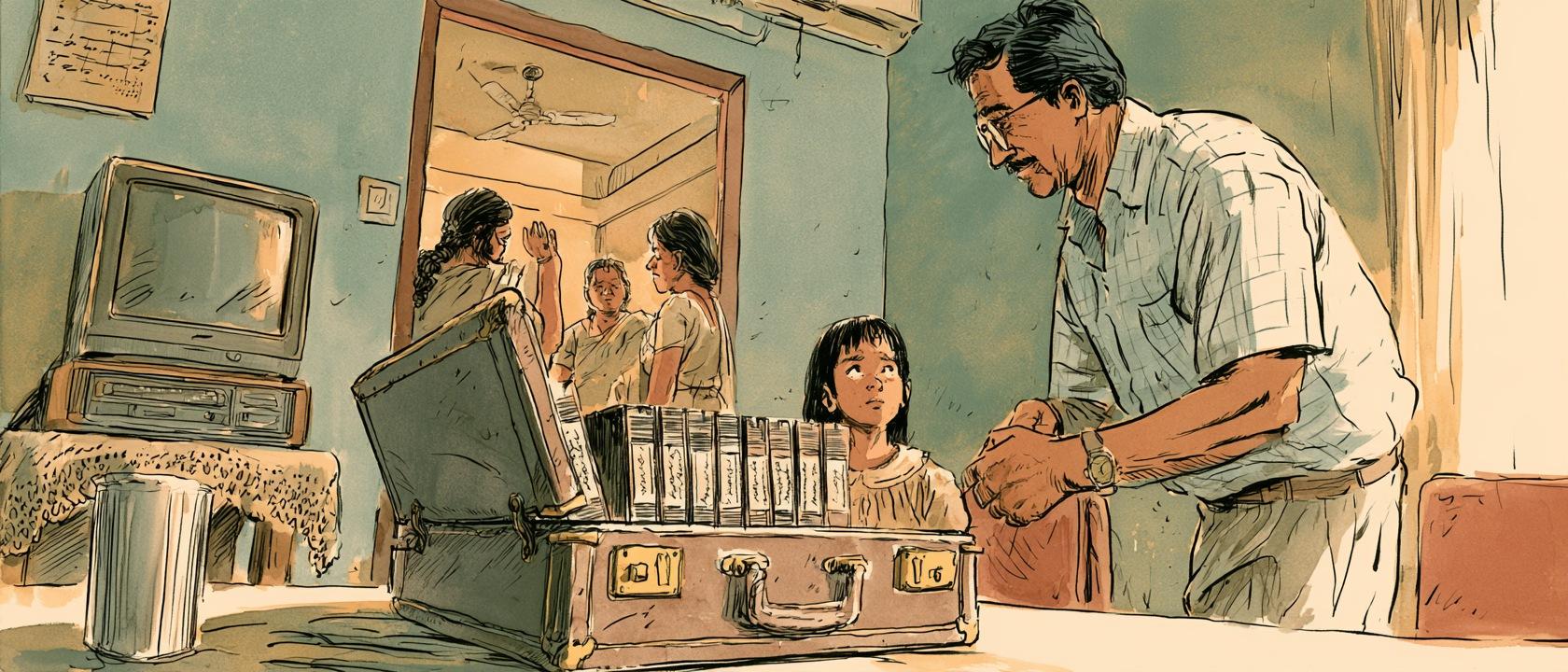
A Wednesday afternoon, sometime after three.
The bell goes, and it's him, and I have been waiting for this since about Tuesday.
Vipul uncle is not a large man but the briefcase makes him important. He sets it flat on the dining table, works both catches with his thumbs — that double snap — and opens it, and inside, standing upright in rows like files, are the cassettes. He turns it towards us the way a jeweller turns a tray.
Last month's release, which is this month's release as far as we're concerned. A Chitrahaar compilation, songs only, no talking. Two cartoons, one of which I have seen twice and will take again. And at the back, the one Mum has been asking about for three weeks — the Pakistani play everybody on this floor is watching, one cassette at a time, the way you'd ration something.
The decision was made before he arrived.
By then Mum and the aunties have already conferred on the landing and settled who has seen what, who is halfway through, and which house will rent which. Each flat pays for one cassette. Each flat sees four. It is a completely informal arrangement, enforced entirely by the fear of being the person who kept something too long, and it works better than most systems I have worked with since.
For a while we had no machine. The VCR came from a shop on rent with a deposit, or from the retired uncle on the second floor, who lent it rarely and with instructions — or, better, we went to his house and sat on his floor. Then we got a player of our own, and much later, one that could record, which changed everything.
Because then there was Sunday morning.
Ramayan, and a blank cassette, and Pappa crouched in front of the machine getting the timing right, because there is no going back and doing it again. The lane outside is silent for that hour. Afterwards the cassette gets a label in his handwriting — straight, small, the episode numbers listed as they accumulate — and goes into the cupboard with the others, and within a year we have a shelf that is, in its way, a library.
A cassette that has been watched too often gets lines through it. You learn to live with the lines.
Movie night is planned, not stumbled into. Mum starts in the afternoon, and by evening there is a first round of something hot, and we are all on the floor and the sofa in the one room, lights off, and the machine takes the cassette in with a clunk and a long mechanical thinking sound before anything happens.
And then the thing I remember better than any film.
A song starts, and she gets up. Not because she doesn't like the songs — because the songs are the part you can afford to miss, six minutes of guaranteed nothing-happening, and she uses every one of them. She's in the kitchen with the next item on the heat and the music reaching her from the other room, and she comes back just as the last line is finishing, with a plate, and sits down, and asks what she missed, and we tell her: nothing, it was a song.
There are forty thousand things available to me tonight, instantly, in better quality than we ever had, and no deposit and no returning and no rewinding and nobody to wait for.
We can pause anything now, so nobody has to plan around a song. And because nobody has to plan around a song, we don't watch at the same time any more — four people, four screens, four different shows in four rooms.
I don't miss the lines on the tape. I miss my Mum coming back with a plate just as the song ended.
Editor's Note: The author conceived this article from her lived experiences and drafted it with assistance from Claude, using her own inputs and reflections. The illustration was generated with Midjourney.
(Kanchan Shine is a daydreamer with a notebook. She reads more than is sensible, watches people slightly longer than is polite, and has never lost the habit of asking how a thing works — or when it quietly stopped working that way. She's an author and former entrepreneur, now serving as Chief Learning and Innovation Officer for Hurix Digital, where her weekdays go to learning design and artificial intelligence. She's also the author of Sticky Learning: From A to Z. Here, she's off duty — writing about whatever she's noticing at the moment.)