
The Blue Bottle
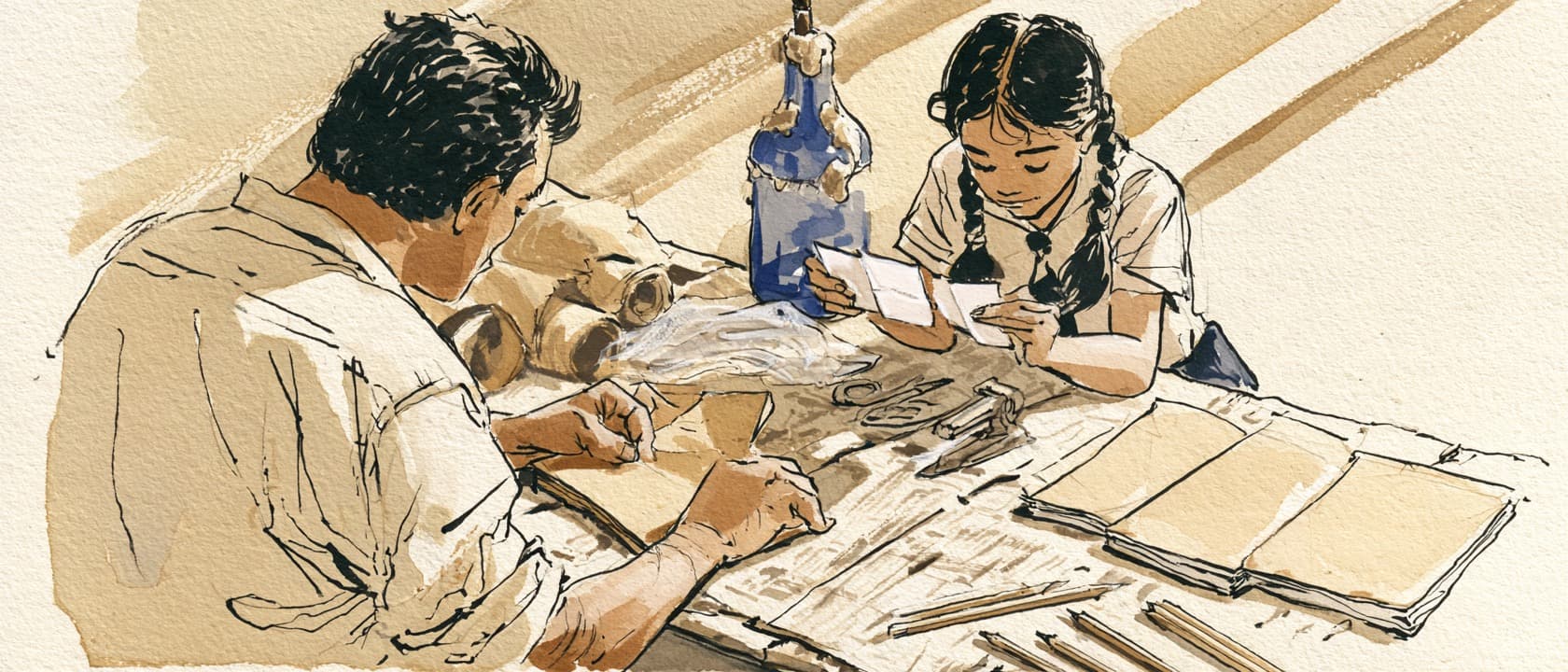
The week before school: a father, a daughter, and the blue bottle. (Illustration generated with Midjourney.)
The first week of June, school reopens on the thirteenth
The stationery shop (Anjali Book Center) at the corner has been waiting all year for this week, and it knows it.
You can smell it from the door — paper, mostly, but also rubber and glue and the particular sweetness of new erasers, and underneath that the pencil shavings of everyone who came in before us. Everything is stacked in towers. Geometry boxes in a wall of tin. Scales hanging in bunches like bananas. A boy ahead of me is refusing, on principle, any pencil box that does not have the two buttons on the side, and his mother is explaining the concept of money, and he is not listening, and I understand him completely.
We come away with the list: brown paper, a roll of the clear plastic, a sheet of white labels, a box of pencils, an eraser, a sharpener, a steel tiffin box and a water bottle with a strap. The bottle smells of new plastic, which is not a nice smell, but it is this smell, and it means what it means.
At home I do the thing I do every year. I take each new notebook, hold it by the covers, and push the middle pages open with my thumbs until the spine gives that small crack, and then I put my face into it and breathe in. Ink and paper and the factory. Nobody has written in these yet. Nobody has got anything wrong in these yet.
Pappa comes home at seven, and we have tea, and then the table is cleared.
This is a specific event. The newspaper goes down first, edge to edge. Then the roll of brown paper, the plastic, the scissors, the stapler, and the blue bottle of glue with the brush standing in its neck — a bottle that has been in this house for years, that gets gummed around the rim, that he wipes on the lip before every stroke. He takes one book at a time. Measures by eye. Cuts. Folds the flap down with his thumbnail so the crease is a line, not a suggestion, and then does the corners — a diagonal tuck, sharp as a hospital bedsheet, that I have watched maybe forty times and still cannot do. Staple. Turn. Next.
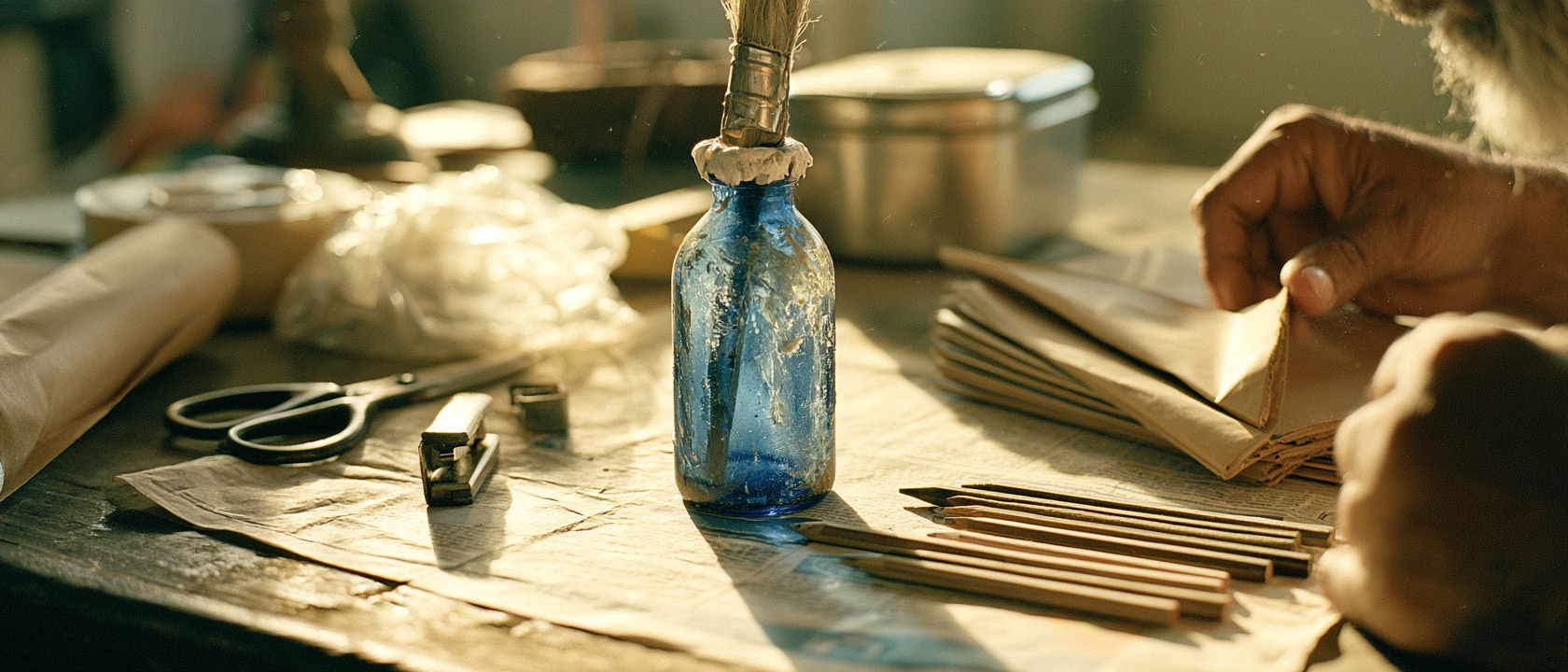
Then the whole thing again in plastic, which is worse, because plastic takes a bubble and holds a grudge, and he smooths from the centre out, slowly, the way you'd calm something.
I have my own department. The labels — name, standard, division, roll number, subject — in my best handwriting, which I practice first on the back of one, and which is never as good on the real one. And the pencil box, which I set up the way other people arrange a room. Six pencils, sharpened to the same length, points all facing the same way. The eraser in its corner. The sharpener that I will lose by August.
Nobody says a word about any of this. It just happens, every June, in the same order, at the same table, with the same bottle.
The books come laminated now. They arrive in a carton, or they don't arrive at all — they're a login, and a tablet, and a folder of PDFs that a school shares on the first day. Nothing needs covering. Nothing needs measuring. There's no evening where a father clears a table and a child is allowed to hand him things.
The year used to have to be made. By hand, at a table, with a brush and a bad bottle of glue, the week before it began — and by the time it began, you had already touched every single book you were going to open.
Editor's Note: The author conceived this article from her lived experiences and drafted it with assistance from Claude, using her own inputs and reflections.
(Kanchan Shine is a daydreamer with a notebook. She reads more than is sensible, watches people slightly longer than is polite, and has never lost the habit of asking how a thing works — or when it quietly stopped working that way. She's an author and former entrepreneur, now serving as Chief Learning and Innovation Officer for Hurix Digital, where her weekdays go to learning design and artificial intelligence. She's also the author of Sticky Learning: From A to Z. Here, she's off duty — writing about whatever she's noticing at the moment.)