
SwaraTuner: A Flautist, His Guru, and a Tuner for All
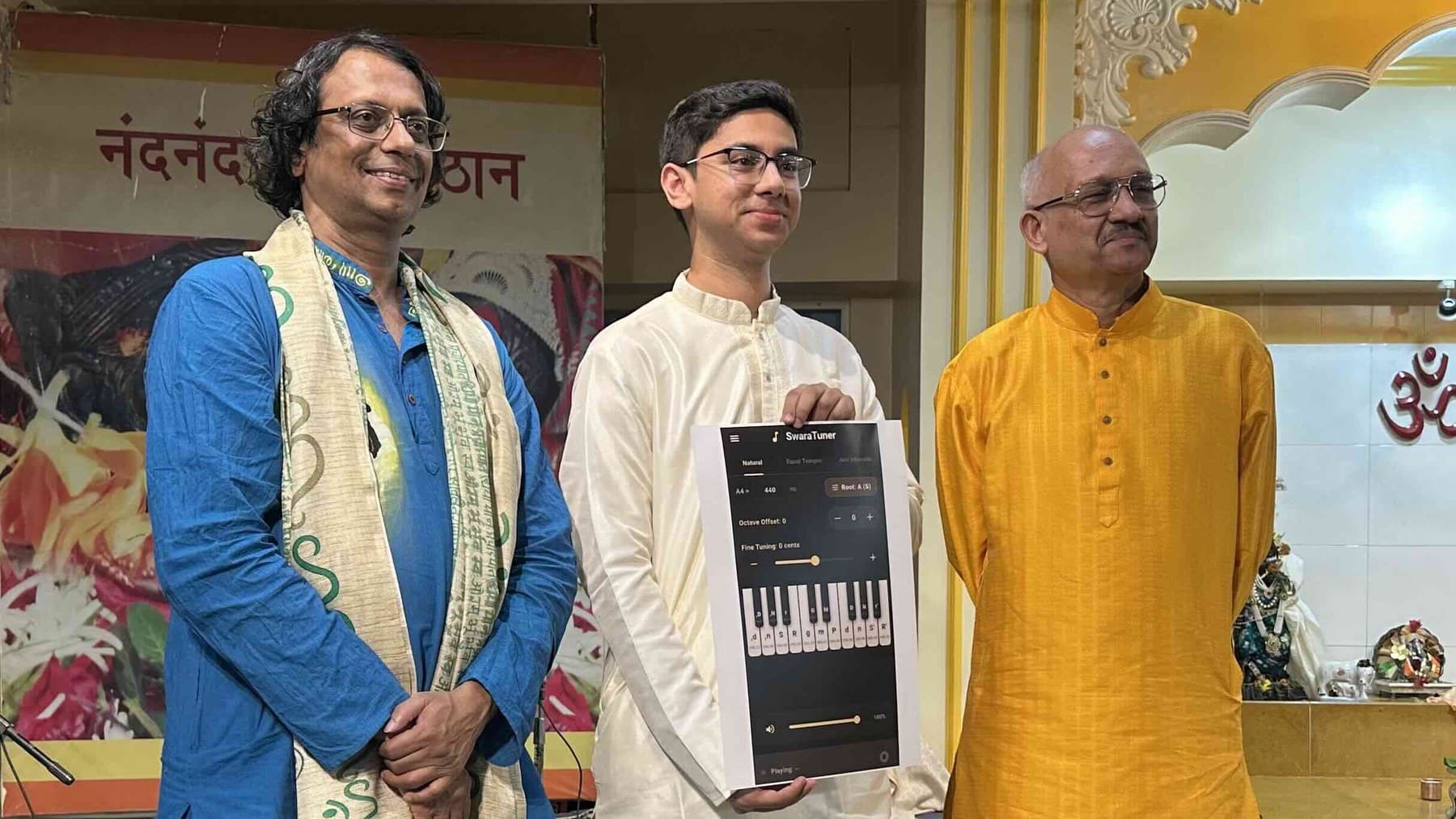
(Left to right): Pandit Milind Date, Ninad Barve and Colonel (Retired) Shrinivas Pande (co-Founder Member of SPICMACAY Pune) at the soft launch of the SwaraTuner app in Pune
He is 24, curious, and a product of formal, structured, theoretical education, classic Indian oral tutelage and the immersive integrated learning approach of traditional guru-shishya parampara.
He likes rock, pop, western classical and light music for leisure listening among other genres. His day job is as a software engineer. He has co-authored papers on data augmentation methods and object-based style transfer. By discipline he is an accomplished flautist, a senior disciple of renowned Pune-based flute maestro Pandit Milind Date.
I first noticed Ninad Barve in 2023 at a flute recital. His poise, clarity and proficiency stood out, making the performance noteworthy. Born and brought up in Pune, Ninad completed his schooling from Deccan Education Society School (Tilak Road), going on to complete his higher secondary certificate in science from SP College and then earning his Bachelor’s degree in Computer Engineering from COEP Technological University.
Earlier this month (4th October 2026), I watched him perform again and the leap in abilities was not astounding at all - a testament to him, his guru and the method of instruction.
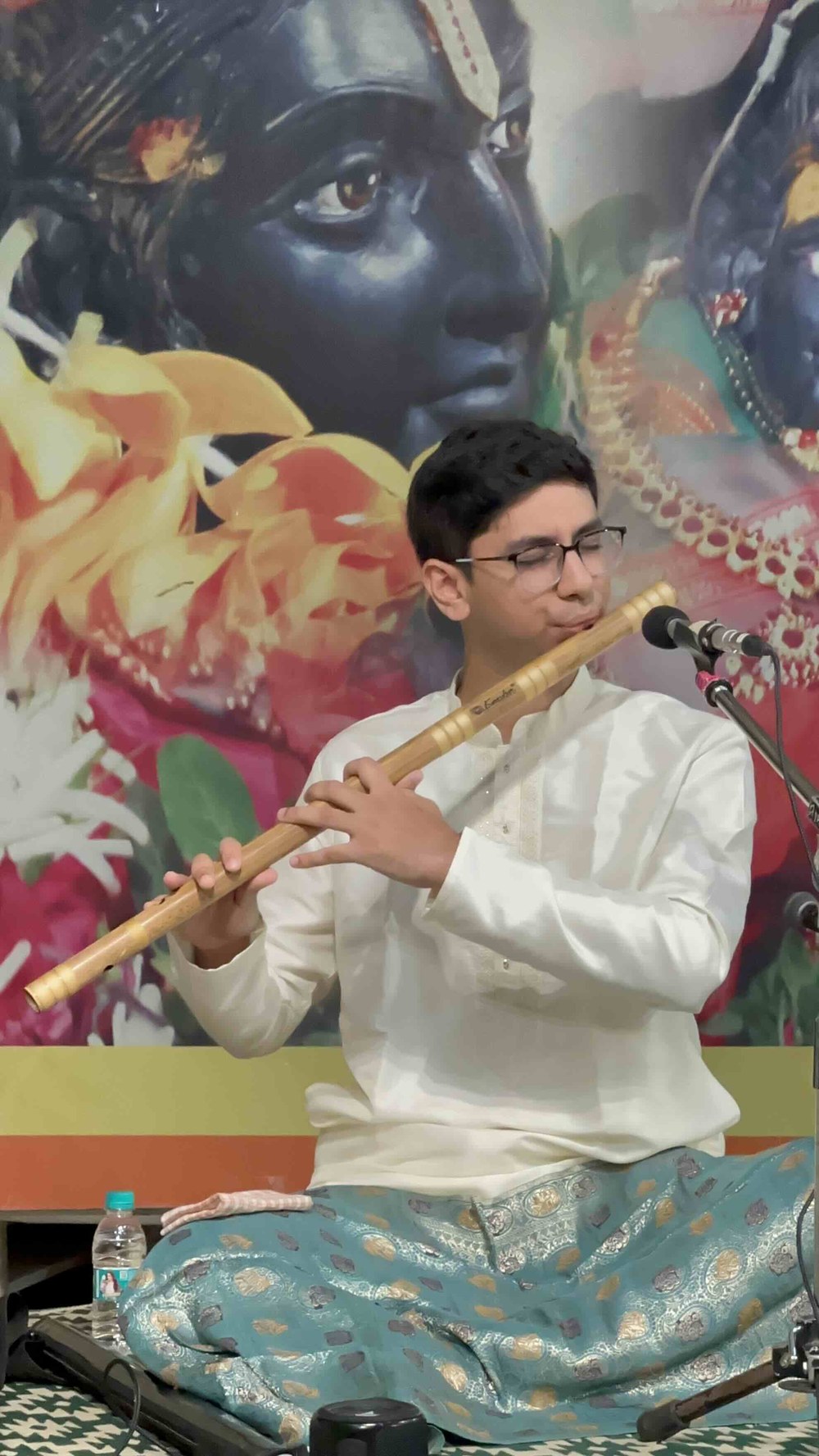
Ninad Barve during his flute recital presenting Raag Bhoop.
What was exciting for me was that Ninad soft-launched SwaraTuner, an app he has designed and developed for the Indian Classical Music ecosystem that he is a part of.
In an age when building an app is no longer news, Ninad set out to solve a problem that his guru asked him to address, a problem that makes life difficult for instrument makers and artists alike in India.
The following is an interview with Ninad on SwaraTuner, on the specific requirements of tuning instruments used in Indian Classical, on how classical music has helped shape him and on how his different worlds come together.
What does your app do?
For a very high-level description, my app gives you the correct frequency for every note. But it is way more than just a tone generator.
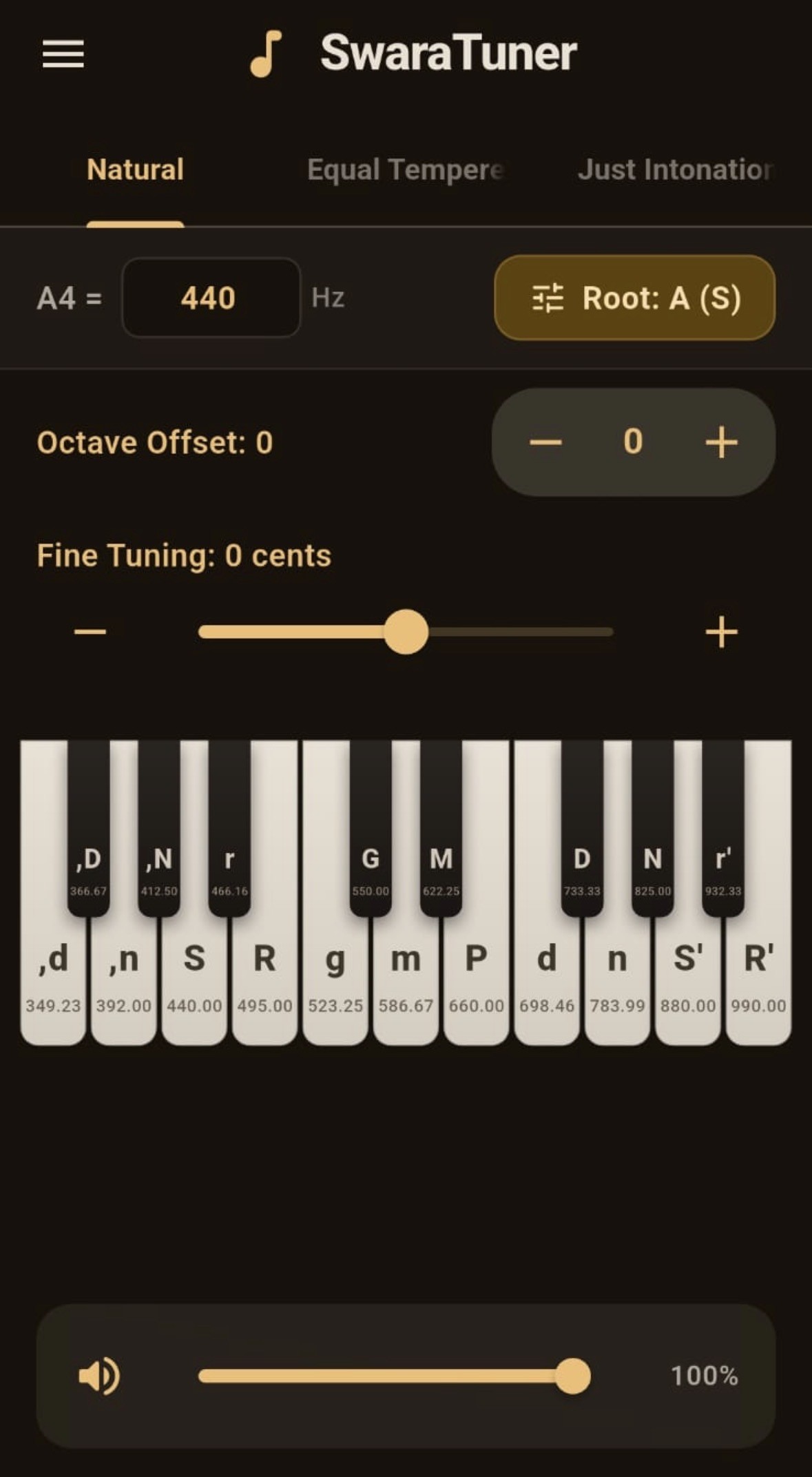
SwaraTuner will be available through the Google Play Store in Diwali
Who is it for?
This will be useful for practically everybody from instrument makers to students.
The main targeted user base is instrument makers, and then the instrument users also, who are confident to fine-tune their own instruments. The app will help fixed-note Indian instrument makers creating instruments like flute, harmonium, organ, shehnai, santoor, and even tabla, tanpura, sarangi, sitar, veena - the possibilities are many.
Why did you build it and how is this different from tuning apps already available?
During the initial search, most of the apps we found followed the Western tuning system, which follows the Equal Temperament scaling. This scale is a logarithmic scale, i.e. the ratio between the next note and the current is 12th root of 2. Western music adopted this system to have perfect chord progressions while shifting the base key, as is the case in many pieces.
Indian classical music (ICM) uses Natural Tuning, also called Just Intonation. This uses whole number ratios, e.g., for any Sa, the Pancham is exactly 3/2 times Sa. Due to this basic difference in the ratios, when ICM is played on instruments tuned using the Western system, apps with this calculation were not easily found; hence I felt the need to create one.
Is the app built around a particular tuning system: shruti, just intonation, raga-specific intonation?
The focus of this app is to assist in the tuning of instruments in their basic state. This app is built around the Just Intonation tuning system. Currently, the first version will not have any shruti-based tuning; most of the time instruments are tuned to the natural scale. But having this built in is an attractive proposition.
Does the app consider gamakas, and the fact that a note in a raga is often a movement around a pitch, not a fixed frequency?
No. In the case of gamakas, it is a technique of how you play the notes. The note being a movement around a pitch, we call it an “aandolit” swara; this again is a way of presenting a particular note during improvisation. The underlying note will always have a fixed pitch; the only difference is in the way it is presented.
Would Komal Re in one raga be tuned differently from the same note in another raga?
The tuning of the same note slightly differently for different ragas is the concept of “shrutis”. Some ragas have shrutis defined. For example, the Shuddha Ni in Raag Chandrakauns is a sharper shruti than a normal Ni. So as per the rules of the raga, the same note can be tuned differently. However, if the instrument is tuned to that Ni, playing other ragas on the instrument will be incorrect.
How does the app set Sa, since singers and instrumentalists move it constantly?
This app is targeted towards primarily instrumentalists. It is an accepted scientific standard that the frequency of A4 or “middle A” is 440 Hz. Based on this, the expected frequencies in the scale for other pitches are calculated in the app. However, if someone sets their Sa slightly sharper, the app has a function for the user to be able to set the A4 frequency. In the world of piano, there are some examples where piano players tuned their whole instruments slightly sharper, considering A4 = 442 Hz, overall making the sound brighter.
Which instruments does it support, and which was hardest?
This app is a one-stop solution for tuning all Indian classical music instruments. Especially instruments where there are fixed notes. Instruments like the harmonium and the organ where one note has its own reed, then flute and shehnai where every note has its hole, santoor with multiple strings for the same note. It will also be helpful in tuning the drone strings or “chikari” strings on sitar, veena, sarod. Tuning tanpuras will be easier especially when the raag expects the tanpura to be tuned to Ma or Dha with Sa (instead of the standard Pa-Sa tuning).
What role did AI or machine learning play, if any?
AI was used in coding and development of this app, but the actual functionality is purely mathematical, and based on ratios.
Who has tried it, and did anything surprise you?
Currently, my guruji Pandit Milind Date is using this app to help fine-tune his and his students’ flutes constantly. In class, whenever it seems a particular note of our flutes sounds off, he uses the app to confirm his suspicions and help fine-tune it. Mr. Nilesh Pote, a leading flute maker (Kanha Flutes), has also used the app.
Traditionally, tuning is learned by ear from a guru. Does an app risk weakening ear training, or can it strengthen it?
This app is a very helpful tool and will strengthen ear training, in my opinion. The app provides the correct frequency, so eventually the ear will be accustomed to correct frequencies.
You are an engineer and a classical flautist. How did the two come together in this app?
As a classical flautist, choosing a new flute is mostly about finding the one which is well in tune from the lot. I get my flutes from Kanha Flutes (Nilesh dada makes some amazing flutes!) and they are almost always very close. But sometimes for one or two holes some fine tuning is needed, which I do with the help of my guru, Pandit Milind Date. The recurring problem always was not having the reference note, and using tuners gave the Western X Indian tuning clashes; so my guru asked me to develop something for this. This is where the engineer in me took over. I came up with a draft, how the app can look, what features it should have, and, post discussions, took help of AI with coding the app. I had sir try it out in actual tuning sessions when some fellow students were getting new flutes, took feedback, and built the current version over a few iterations.
What role does music play in your life, and how does it shape you?
Music has been a part of my life as long as I can remember. My parents and grandparents love classical music; I grew up with it. I also loved listening to Geet Ramayan; I used to sing along with Babuji on the cassette. My first formal classical music training was in harmonium, giving me a strong foundation leading to the flute.
The hours spent practicing teach you discipline, attention to detail, patience - which are all required daily in other aspects as well. Music teaches you to enjoy the fine hidden details everywhere. As a listener, my music taste is very wide: Western symphonies and violin concertos, rock, pop artists like Taylor Swift and, recently, Gracie Abrams. In ICM, I love listening to Pt. Hariprasad Chaurasia, Pt. Ravi Shankar, Pt. Nikhil Banerjee, Pt. L. Subramaniam, mostly instrumentals. I am usually more inclined to go visit a classical program in the city, but recently I did buy tickets to Sunidhi Chauhan's live show for the experience.
What is next?
The feature of being able to provide frequencies of all 22 shrutis in Hindustani and 24 shrutis in Carnatic schools of music is in the works.
Another app targeted towards students of ICM is in the works, called "Swaralankar". It is an alankar-generation app, where you can create any patterns of your choice and the app will provide you with the entire notation for the whole saptak. The ability to generate alankars while following the rules of the raga is also in the roadmap for this app.
What's one thing about Indian music you only understood after building this?
We know about the cycle of fifths, but if you follow that cycle in Indian instruments and Western instruments, the same note you end up on is in different frequencies.
The Indian instruments should be tuned more to how natural the sound feels to our ears. Western tuning is so that chord progressions while shifting the root key don’t sound off.
Where can musicians get the app, on which platforms, and what does it cost?
This app will be made available only on the Google Play Store, and it will be free of cost. My aim is to launch in Diwali.
Sanjay Mukherjee is the editor of The Learning Equilibrium and the founder of Eduriti, an AI-native product studio. He has worked across journalism, talent transformation, L&D consulting, and creative fields. His work as a journalist has focused on youth culture, education, and business. He was also resident food and music critic for Pune Times of India. He is the author of several books including “Talking to Claude and other AIs” (2025) and is based in Pune.