
The Stall That Taught Me What India Is Missing
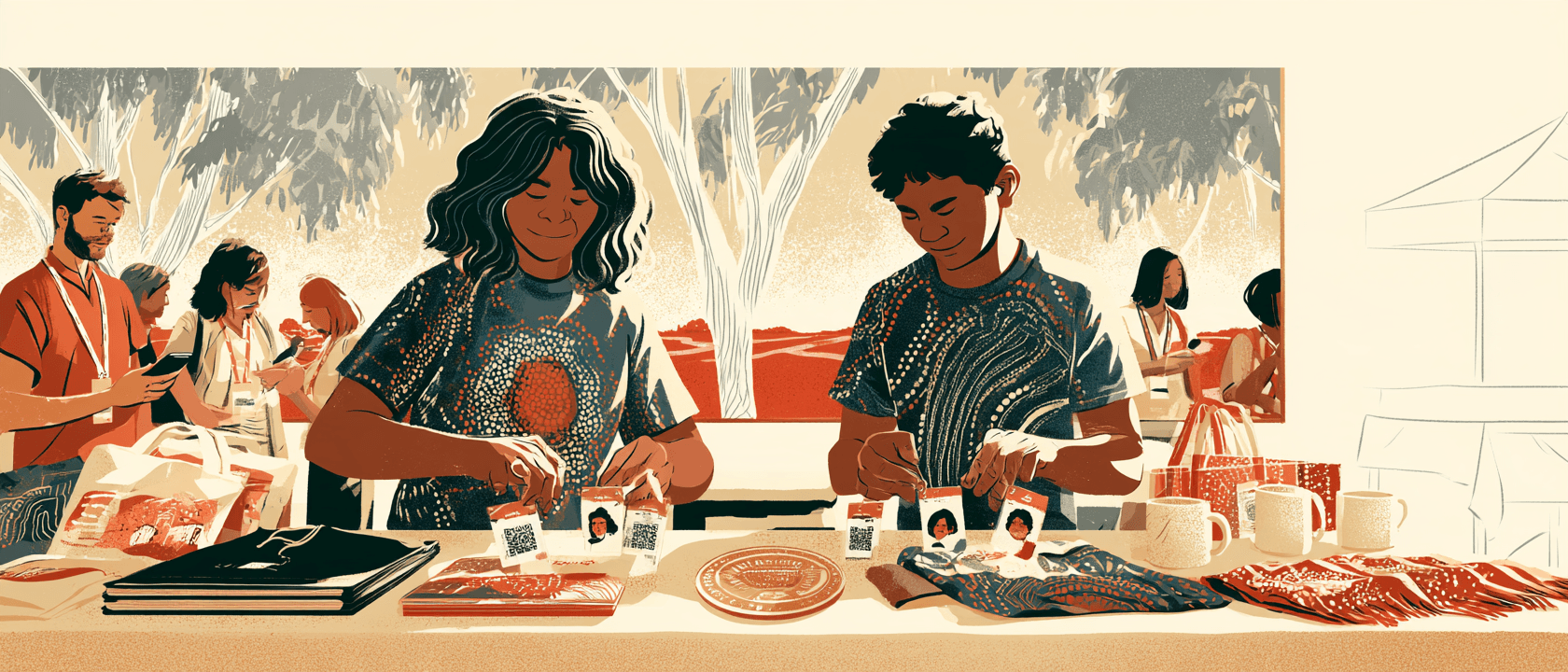
At the AAA/AIMA 2025 conference in Fremantle, products at the First Nations-run merchandise stall were tagged with the Indigenous artist's name. If a community can turn a stall into a statement of identity, why can't a country with thousands of years of art do it at scale? Illustration generated with Midjourney: a generic representation of First Nations peoples in a modern urban conference setting. It may not be accurate with respect to any particular First Nations community or any particular conference setting.
At the 2025 AAA/AIMA conference, I went for the sessions and remembered the stalls. The official T-shirts and shirts weren't printed by a faceless vendor. Members of the First Nations communities were selling them, along with curated merchandise that carried their identity. Nobody was apologising for commerce. Culture was simply being sold, and sold well.
That isn't an accident. Australia has spent years building the scaffolding around it: consultation, licensing, and rules about who may sell what. The clearest example is the First Nations art market. A Productivity Commission report found that two in three products in the roughly $80 million Indigenous-style souvenir market are fake, with no connection to Aboriginal and Torres Strait Islander people. Instead of shrugging, the government is developing stand-alone legislation to tackle fake art, merchandise and souvenirs, and it commissioned a review of the Indigenous Art Code, led by the First Nations consultancy Cox Inall Ridgeway.
Around that policy, an ecosystem has grown. Yarn describes itself as Australia's largest marketplace for First Nations fashion, homewares, uniforms and merchandise, and Aboriginal Retail Australia launched in 2025 to support First Nations businesses. The lesson is that identity becomes an economy when someone builds the pipeline: design, licensing, retail and trust.
Now look at India. Madhubani earned a GI tag in 2007. Warli's application was filed in 2011 and certified in 2014. Yet critics argue that middlemen still dominate the flow of information and customers, and a May 2026 report on Warli says enforcement remains limited. The market has slowly moved beyond canvases to sarees, tiles, mugs and laptop sleeves. But walk through any Indian conference or festival and ask what you can buy. Usually it's a painting, a stole, a keychain. Where is the range?
India has hundreds of living art forms: Gond, Pattachitra, Kalamkari, Phad, Sohrai. Imagine them as notebooks, stationery, tote bags, event uniforms, board games, phone cases, home textiles and corporate gifting, sold at frequent stalls at every conference, college fest and airport. Imagine each product carrying a QR code that names the artist and the village.
Australia's experience also carries a warning. Commercialisation without protection floods the market with fakes and leaves artists out of the profit. The aim shouldn't be more merchandise alone. There should be more merchandise with provenance, where the artist is credited and paid.
So here is the question that kept me thinking. If a community can turn a conference stall into a statement of identity, why can't a country with thousands of years of art do it at scale? What is missing: the artists, the buyers, or the system between them?
(Anindya Sanyal is a Doctoral Researcher in Archaeology at the Banaras Hindu University, Varanasi. He has a Master of Arts degree in Ancient Indian History, Culture, and Archaeology, and works on field projects in rock art, human-faunal interactions, and ethnography.)