
Anga: The Eastern Kingdom in the Shadow of Magadha
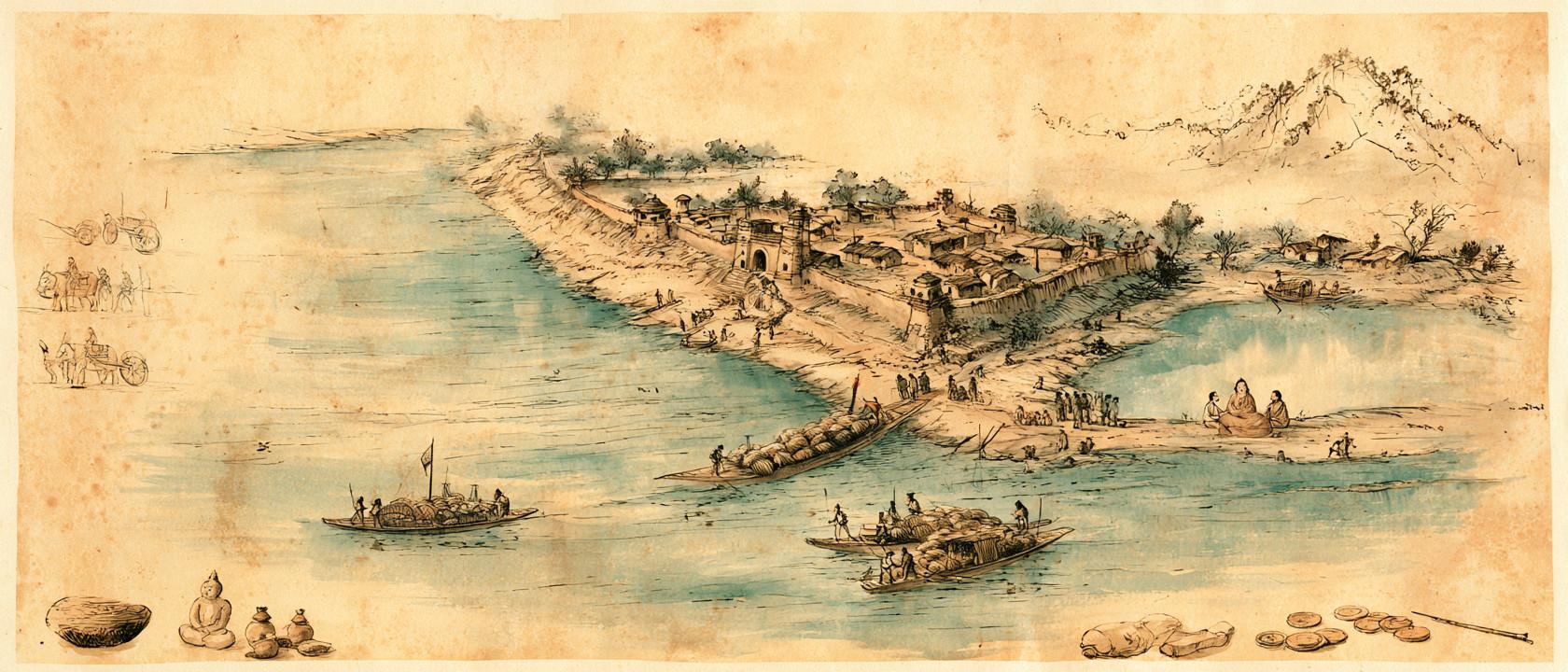
Anga and its capital Champa, c. sixth century BCE. An illustration based on the finds from the Champa excavations; details and positions are indicative.
Part 02 of 17 | Sixteen Realms Before the Empire
| Mahajanapada | Anga |
|---|---|
| Capital | Champa |
| Geographical Location | East of Magadh to West of Raj Mahal Hills |
| Neighbours | North - Vajji; West - Magadh |
| Important Rulers | Anga Vairochana |
| Conflict | Magadh |
| Merger | Magadh |
| Type of Governance | Monarchy |
| Religion | Historical Vedic, Buddhism, Jainism |
| Economic Activities | Trade and Commerce |
Before Magadha became the dominant power of the eastern Gangetic plains, another kingdom flourished to its east. Its capital was Champa, a city remembered in ancient literature for its prosperity, merchants and religious associations. This was Anga, one of the sixteen Mahājanapadas, whose history offers a glimpse into the changing political and urban world of early India.
Anga occupied the region broadly corresponding to present-day eastern Bihar, particularly around Bhagalpur and Munger. Its capital, Champa, is generally identified with the archaeological remains near Champanagar and Nathnagar, close to Bhagalpur. The city's location near the Ganga and the river Champa placed it within an important network of riverine communication. In an age when rivers connected settlements and facilitated the movement of goods, this was no ordinary geographical advantage.
Champa also appears in an engaging episode in Buddhist literature. The Sonadaṇḍa Sutta of the Dīgha Nikāya describes the Buddha visiting the city and meeting a learned Brahmin named Sonadaṇḍa. The encounter takes place near the Gaggarā Lake, where the Buddha's presence attracts a gathering of people. Beyond its religious message, the account gives us a glimpse of Champa as a recognised urban centre, associated with influential Brahmins, householders and the wider political world of the time (Walshe 1995).
But what did this city actually look like? Archaeological excavations at Champa, undertaken by Patna University during the late 1960s and 1970s, provide some fascinating clues. One of the most striking discoveries was a massive mud rampart. In the 1970–71 excavation season, a phase of this fortification was recorded with a basal width of approximately fifteen metres and a surviving height of nearly five metres. Such construction points to considerable organisation of labour and investment in the protection and planning of the settlement.
The objects recovered from the excavations bring this ancient city closer to us. Pottery included Black-and-Red Ware and Northern Black Polished Ware, alongside other ceramic types. Excavators also reported terracotta plaques, human and animal figurines, stone and glass beads, bone points, copper objects and cast copper coins. Ring-wells, brick walls and drains reveal changing arrangements of water management and built space. Particularly interesting were stone jewellery-making moulds, suggesting that specialised craft production formed part of Champa's urban life. These finds do not belong to a single moment: they represent different occupational and structural phases, extending well beyond the age of Anga's political independence (Archaeological Survey of India 1974, 1979).
Champa's story, however, cannot be separated from its powerful neighbour. Buddhist traditions remember an earlier rivalry between Anga and Magadha, including the account of an Anga ruler named Brahmadatta defeating a Magadhan king. The political balance eventually shifted. Bimbisara, the Haryanka ruler of Magadha, is traditionally credited with conquering Anga and bringing it under Magadhan authority. Although the precise chronology of these events remains uncertain, the incorporation of Anga marks an important stage in Magadha's territorial expansion (Singh 2008; Thapar 2002).
For Anga, this meant the loss of its independent political position. For Magadha, it meant gaining control over an important eastern territory and its urban centre. Yet Champa did not disappear from history. Its continued occupation and repeated rebuilding, visible in the archaeological record, suggest a city whose importance extended across several centuries.
Anga deserves to be remembered, therefore, not merely as the kingdom conquered by Magadha, but as an important political and urban centre in its own right. Its history brings us closer to the competition, commerce and changing settlements that shaped the age of the Mahājanapadas.
To understand how the neighbouring kingdom of Magadha transformed itself into the most powerful state of its time, we now turn to its rise: Magadha
References
- Archaeological Survey of India. 1974. Indian Archaeology 1970–71: A Review. New Delhi: Archaeological Survey of India.
- Archaeological Survey of India. 1979. Indian Archaeology 1974–75: A Review. New Delhi: Archaeological Survey of India.
- Bodhi, Bhikkhu (trans.). 2012. The Numerical Discourses of the Buddha: A Translation of the Aṅguttara Nikāya. Boston: Wisdom Publications.
- Singh, Upinder. 2008. A History of Ancient and Early Medieval India: From the Stone Age to the 12th Century. Delhi: Pearson Longman.
- Thapar, Romila. 2002. Early India: From the Origins to AD 1300. Berkeley: University of California Press.
- Walshe, Maurice (trans.). 1995. The Long Discourses of the Buddha: A Translation of the Dīgha Nikāya. Boston: Wisdom Publications.
(Anindya Sanyal is a Doctoral Researcher in Archaeology at the Banaras Hindu University, Varanasi. He has a Master of Arts degree in Ancient Indian History, Culture, and Archaeology, and works on field projects in rock art, human-faunal interactions, and ethnography.)