
Ramayana: More Than a Film, a Celebration of Our Civilizational Heritage
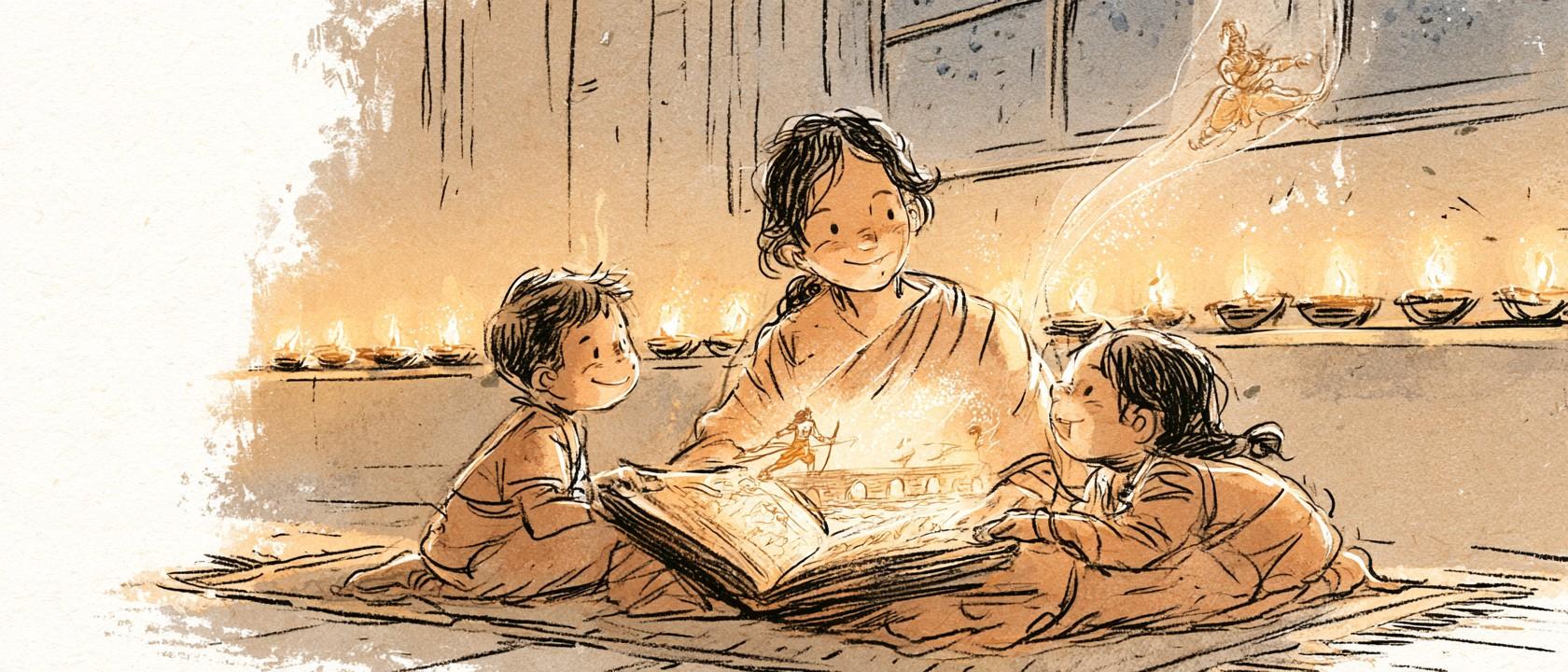
A mother reads the Ramayana aloud; the epic rises from the page. Illustration created with Midjourney.
Every year, Diwali reminds us that goodness and righteousness ultimately overcome evil. With that thought in mind, I went to watch Ramayana on the Saturday before Diwali.
I do not normally write reviews, but I believe Ramayana deserves an exception.
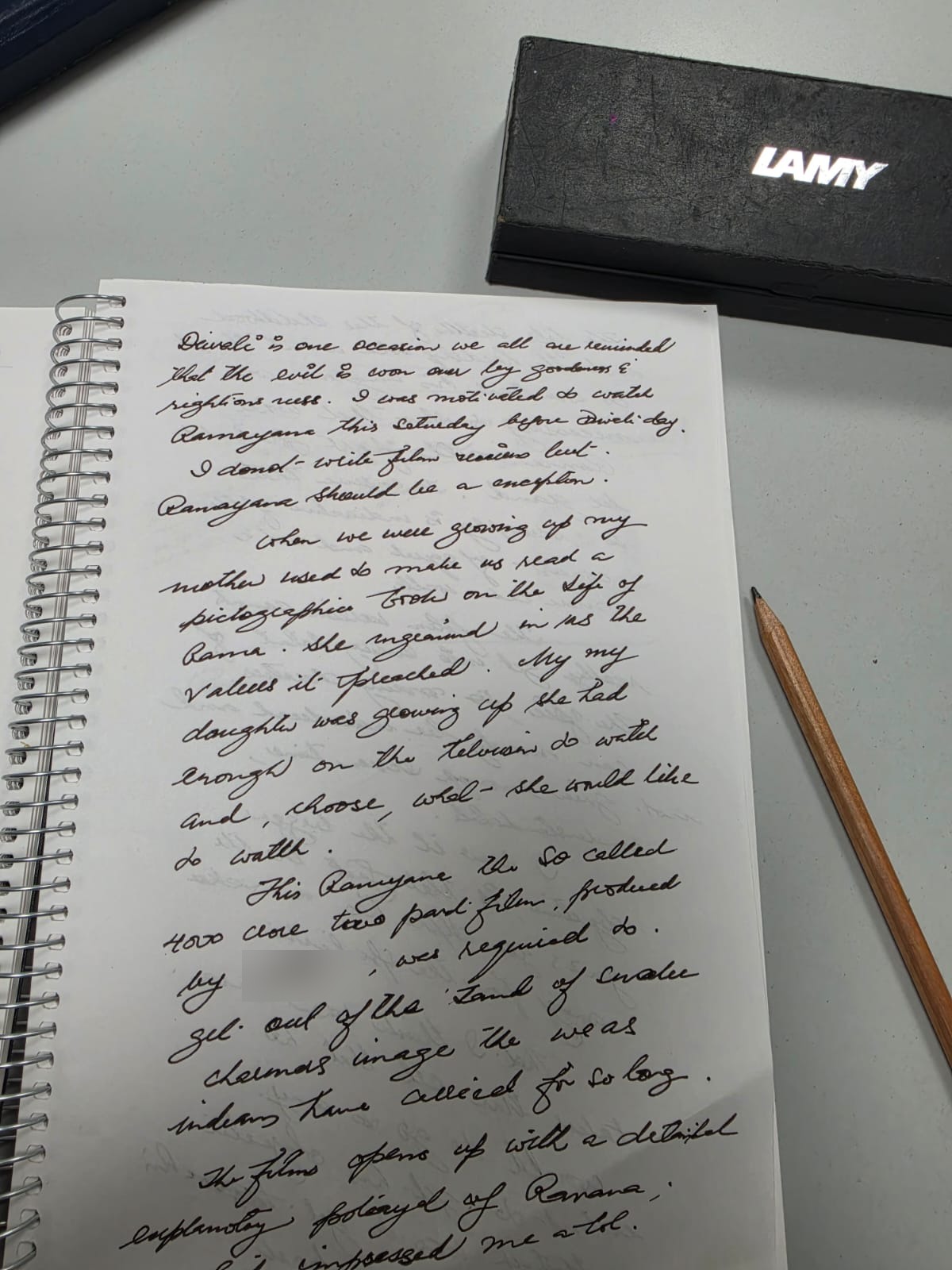
The column began on paper: its first page, in the author's own hand.
When we were growing up, my mother used to read to us from a pictorial book on the life of Lord Rama. Through those stories, she ingrained in us the values the Ramayana preaches. Even today, in the many twists and turns of life, those teachings serve as points of reference and have often helped me choose the right path.
This Ramayana carried an enormous responsibility. It is Part One of a two-part project, directed by Nitesh Tiwari and produced by Namit Malhotra, reportedly made on a combined budget of ₹4,000 crore. It was expected to be grand, not merely in budget or technology, but in the way it represented one of the greatest stories ever told. For far too long, India has been viewed through simplistic stereotypes. The world now deserves to witness the richness of our history, the depth of our culture and the magnificence of our civilization.
With that in mind, the portrayal of Lord Rama had to be larger than life. The film comes remarkably close to achieving that. Technically, it is among the most advanced films I have seen in India. The scale, the attention to detail, the visual effects and the cinematic execution are truly world-class.
The film opens with a detailed account of the times and circumstances surrounding the story. What impressed me most was that, despite having read and heard the Ramayana all my life, I found several insights and details that were new to me. That speaks volumes about the effort and research behind the project.
The journey of Rama has always been about much more than good versus evil. It is a story about leadership, sacrifice, duty and the ability to put the welfare of society above personal interest, and the film captures this well. It reminds us that greatness is not inherited; it is earned through discipline, perseverance and an unwavering commitment to one's people.
What stood out for me was the depiction of Rama not merely as a divine figure but as an ideal leader. In an age when leadership is often equated with power, the Ramayana reminds us that true leadership is responsibility. Rama consistently chooses duty over comfort, principle over convenience and the greater good over personal gain. These lessons are as relevant today as they were thousands of years ago.
Ranbir Kapoor plays Rama, Sai Pallavi plays Sita, Yash plays Ravana and Sunny Deol plays Hanuman. The supporting characters have also been treated with respect and depth. Whether it is Lakshmana's loyalty, Bharata's humility, Hanuman's devotion or Sita's strength and dignity, the film portrays the virtues that have made these characters timeless inspirations.
Another aspect worth appreciating is the film's ambition. Stories like the Ramayana should not be presented apologetically or with modest aspirations. They deserve the very best that modern cinema can offer. For the first time in my own viewing, I felt that Indian filmmakers had told one of our greatest epics with the scale and confidence that Hollywood reserves for its own legends and mythologies.
As Indians, we often underestimate the value of our own stories. Yet the Ramayana has survived for thousands of years, transcending languages, regions and generations. It has inspired kings, philosophers, poets, freedom fighters and ordinary families alike. Few narratives in human history can claim such enduring relevance.
This film is therefore an opportunity for an entire generation to reconnect with its roots. For younger audiences who may not have grown up listening to these stories from their grandparents or reading Amar Chitra Katha comics, it can serve as a gateway to the wisdom embedded in our epics.
Of course, every viewer will have their own interpretation, and every adaptation invites comparison with the version of the Ramayana that lives in our hearts. What matters most is whether the film evokes pride, reflection and inspiration. In my view, it does.
As I walked out of the theatre, I felt the same admiration I had experienced as a child listening to my mother narrate the story of Rama. The technology may have changed, the screens may have grown bigger and the effects more sophisticated, but the message remains unchanged: righteousness ultimately prevails, duty must guide our actions, and character is the true measure of greatness.
In that sense, Ramayana is not merely a movie. It is a reminder of who we are, where we come from, and the values that have sustained our civilization through the ages.
And perhaps there is no better message to carry beyond Diwali.
(Shashikant Jugran is a specialist in business process reengineering, an orator, mentor, and travel industry leader with three decades of experience. A multi-disciplinary professional, Shashikant is a civil engineer who transitioned into management through an MBA in Marketing with a Minor in Human Resources. His illustrious career has spanned leadership roles in Amadeus, Bird Group, RezNext, Yatra, and he currently serves as the Chief Operating Officer at BirdRes Technologies Private Limited, based in Gurgaon.)