
One Tile at a Time
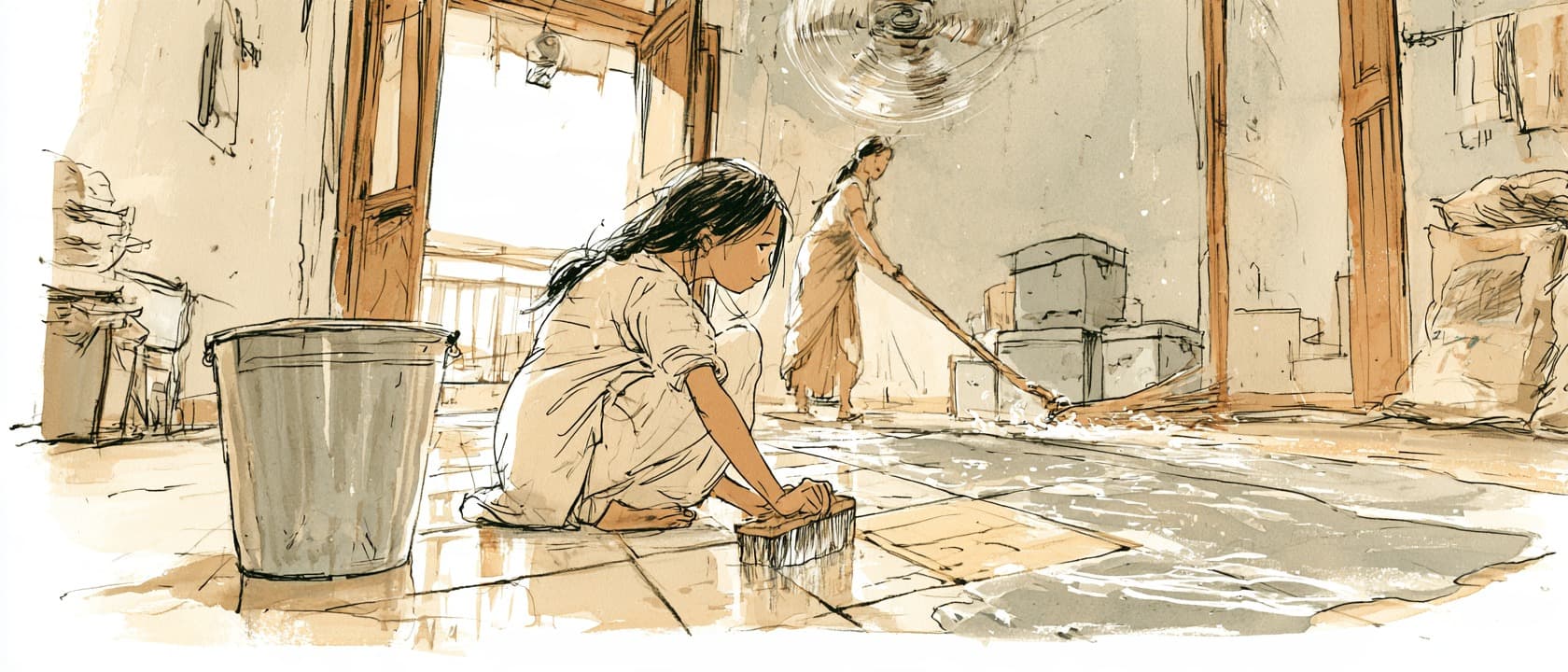
The week before Diwali: a bucket, a stiff brush, and a floor to be read one square at a time. (Illustration generated with Midjourney.)
The week before Diwali
The groceries come up the stairs first, and you can read the whole week in them.
Sugar in a sack. Maida, rava, besan, each in its own bag with the top folded twice and tied. A tin of oil with a lid that has to be prised, and another tin behind it, because there is no such thing as one tin. Then the other list — the cleaning powder, and a brush with bristles so stiff that when you run your thumb across them they push back, which my sister and I both do, in turn, without being asked.
We are put on duty.
She goes first. Dusting, wiping, and then the furniture — out of the room, into the passage, until what is left is a bare box with light in it, which no room in our house ever is otherwise. It looks bigger and slightly embarrassed, like somebody caught without their glasses.
Then me, with the bucket.
I start in the corner, because you cannot start in the middle, and the floor is tiles, and the tiles are a grid, and a grid is a set of instructions. Powder, water, brush. One square, scrubbed until the water in it goes grey. Then the square next to it. Then the whole row, and the row after, and somewhere around the third row my arm begins to complain and I don't stop, because the grey water is proof. A year gets into a floor. You can see it leaving.
Mum puts the fan on full, which turns the whole room into weather, and comes in with the broom — not the soft one, the other one, the wooden sticks bound at the top with plastic wire — and pushes. The water goes ahead of it in a long grey wave, gathering the last of the powder, out of the room, across the balcony, to the nozzle in the wall. And then it leaves the building. Five floors of falling water in a rope, hitting the ground with a slap you can hear from up here, and somebody below shouts something, and Mum says something back without stopping.
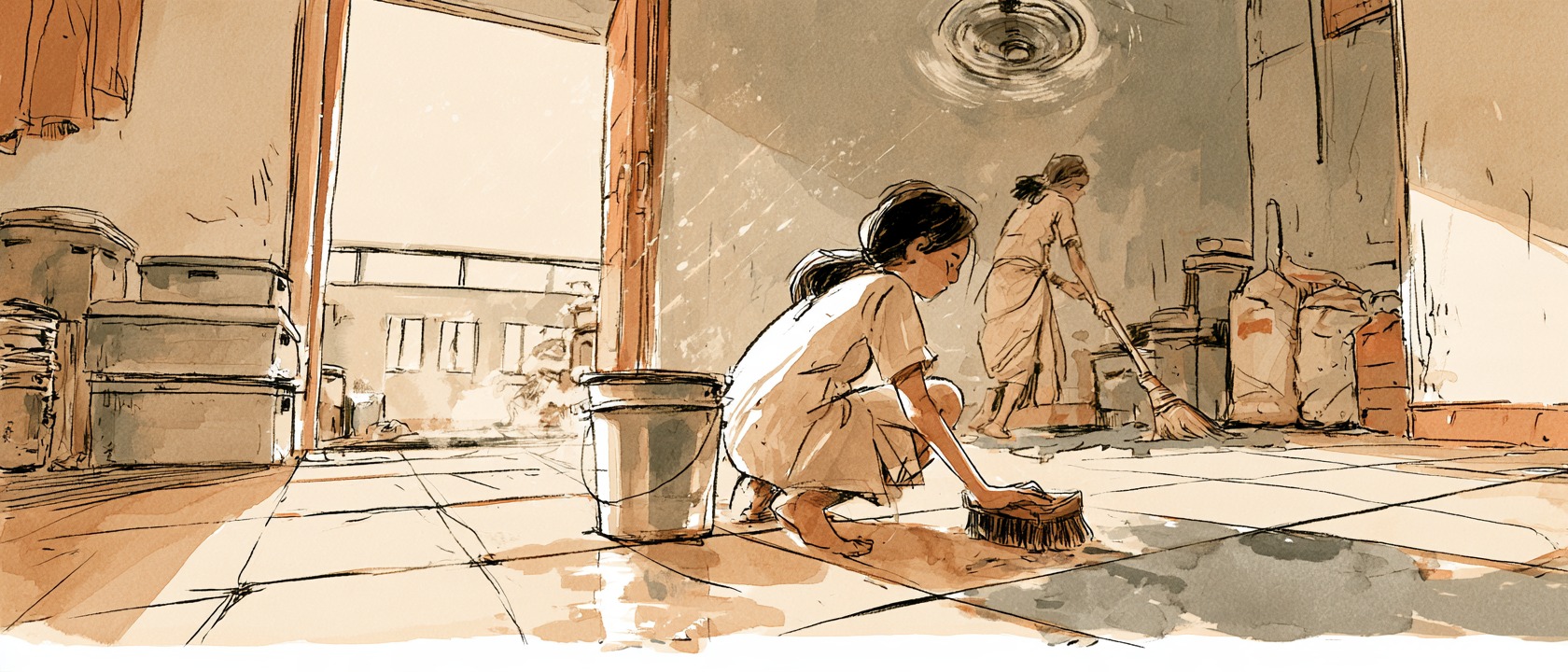
Then the mop, clean, twice. And the room is finished.
We sleep in the afternoon. The floor is still drying and the whole flat smells of it — wet stone and powder and something almost metallic, cold and clean — and the fan is still going, and that is the best nap of the entire year. Nobody has to say so.
By evening the kitchen has taken over.
It starts with a smell like a bakery leaning out of a window: nankhatai, ghee and sugar and cardamom, going pale gold and cracking on top. Then the sancha comes out for the chakli, and it creaks as it turns, and the coils come out in long spirals onto newspaper, row after row, drying, waiting, some of them lopsided — mine. The oil gets hot. The first one goes in and the kadhai says so, loudly, and everyone in the house knows by that sound alone what stage we are at. Besan roasting. Ajwain. The tin boxes lined with more newspaper, filling up, stacked, and the rule that nothing is to be opened until the day, which is a rule and not a fact.
We are allowed one. For testing.
The sweets come in a box now, with a ribbon and a card and a plastic tray moulded to hold them apart. People come to clean the house, and they come on a Tuesday, and they are gone by four, and the furniture never leaves the room. It's all much better, and nobody is on their knees in October with a brush and a bucket.
But the house was never so clean as the year we scrubbed it ourselves, one tile at a time — and I have never again slept the way you sleep on an afternoon when you can smell the floor.
Editor's Note: The author conceived this article from her lived experiences and drafted it with assistance from Claude, using her own inputs and reflections.
(Kanchan Shine is a daydreamer with a notebook. She reads more than is sensible, watches people slightly longer than is polite, and has never lost the habit of asking how a thing works — or when it quietly stopped working that way. She's an author and former entrepreneur, now serving as Chief Learning and Innovation Officer for Hurix Digital, where her weekdays go to learning design and artificial intelligence. She's also the author of Sticky Learning: From A to Z. Here, she's off duty — writing about whatever she's noticing at the moment.)