
One Book a Week
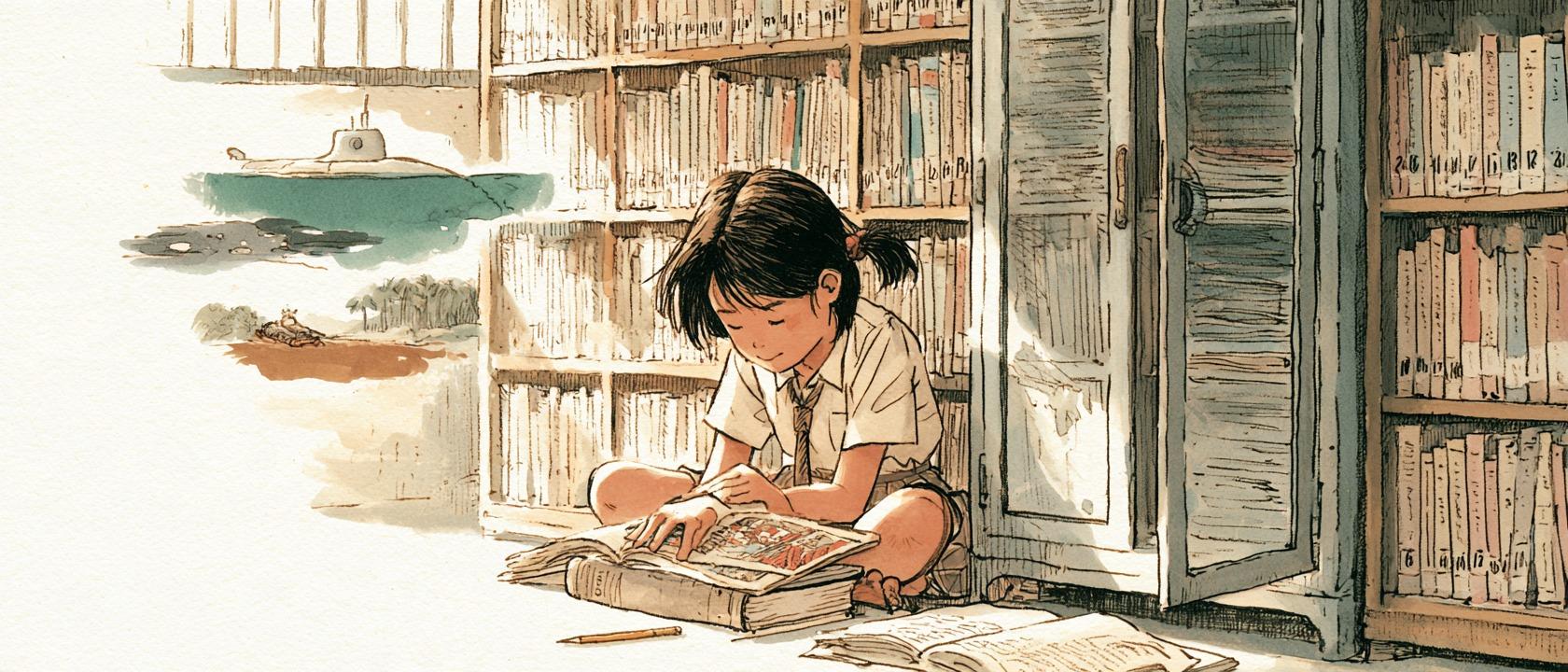
School, the room at the end of the corridor.
The library is about the size of a classroom, and it is the best room in the building.
Open shelves along two walls, and then the metal cupboards with the glass doors that lift up and stick halfway, so you have to know the trick. Within a term I know the trick. I also know the numbering — how the spine labels climb in order, which number means stories and which means the dull section with the maps — and once you know that, a library stops being a room and becomes a set of directions. I can walk in and go straight to my corner without looking up.
One book a week. That's the rule, and it shapes the whole week around it.
I start with the one where the toys come alive at night, and I want to live in it. Then all the fairy tales, in the fat collections with the tissue paper over the illustrations. Then the Famous Five, who are always about to have a picnic, and the Hardy Boys, who are always about to be knocked unconscious.
And then, one Thursday, Twenty Thousand Leagues Under the Sea, which I take out and return and take out again, and again, until the librarian says something about giving other children a chance. I don't care. I am not reading it. I am living on that submarine — the pressure of the water, the great windows, the silence of a man who has decided never to go back. After that, the journey down through the volcano. Then Tom Sawyer, who is the friend I would like, and Huckleberry Finn, who is the friend I would actually have, and then a hound on a moor at night that keeps me awake in a flat five floors above a lit street in Bombay.
The comics arrive through other channels.
The Phantom, mainly — the skull ring, the jungle, the man who is supposed to have lived four hundred years — and Spider-Man, borrowed, traded, returned in worse condition than received. These are not library books. These are currency. They pass between desks in the interval with terms attached, and you honor the terms, because the alternative is being cut off.
And they are read where they should not be read: flat inside the geography textbook, or slid under the open workbook, one hand turning the page and one hand holding a pencil that has not moved in eleven minutes. I get away with it far more often than I deserve to.
The marks at the end of that year are a separate subject, and were discussed at length.
But by then I am living four or five lives at once — one in a submarine, one in a jungle, one on a raft going down a river, one at a desk in Andheri pretending to do sums — and only the last one is being graded.
Supply lines matter when supply is short, and I have three.
An uncle who takes the Reader's Digest and passes on last month's each time he visits — small, thick, slightly sweet-smelling — and I read even the parts meant for adults, and learn more words from that magazine than from any teacher.
An aunt who takes Filmfare and Stardust, which is a large part of why I look forward to seeing her. I sit in a corner of her flat going through the photographs slowly, and then the gossip pages, which I pretend not to be reading.
And somebody's old copy of Chicken Soup for the Soul, handed down, which lives beside my bed and gets read the way you'd read something with no end — opened anywhere, any night, for years.
Then, finally, a subscription at the lending library, and the gates come off.
Sidney Sheldon, two a week. Danielle Steel. Sherlock Holmes, all of him. Agatha Christie, until I begin, worryingly, to guess correctly. Grisham. I don't read these so much as consume them, one after another, in a state my mother refers to as always with a book.
And somewhere in there, Atlas Shrugged, which refuses to be consumed. That one takes months. I put it down and pick it up and argue with it in my head on the way to school — the first book that isn't a place to disappear into but a person to disagree with, and I neither fully forgive it nor fully leave it.
Today every book ever written is four seconds away, most of them free, and the ones that aren't cost less than the bus fare to that lending library.
My children read. Both of them — paperbacks, and a Kindle that holds more books than my school library ever did. I'm glad of it, and I know what a small and lucky club that is.
But not the way we read. Not four books at once, not the same one eleven times, not flat inside a geography textbook with a pencil in the other hand.
I don't think that's about them. We were reading into a space that doesn't exist anymore — an afternoon with nothing in it, a television that showed nothing worth watching until evening, no reel to scroll, no next episode already loading.
We didn't read because we were disciplined or curious or well brought up. We read because there was nothing else. And it turned out there was everything else, in a room the size of a classroom, at the end of a corridor.
Editor's Note: The illustration was generated with Midjourney.
(Kanchan Shine is a daydreamer with a notebook. She reads more than is sensible, watches people slightly longer than is polite, and has never lost the habit of asking how a thing works — or when it quietly stopped working that way. She's an author and former entrepreneur, now serving as Chief Learning and Innovation Officer for Hurix Digital, where her weekdays go to learning design and artificial intelligence. She's also the author of Sticky Learning: From A to Z. Here, she's off duty — writing about whatever she's noticing at the moment.)