
Morning Shows, Video Games and DIZ Nostalgia
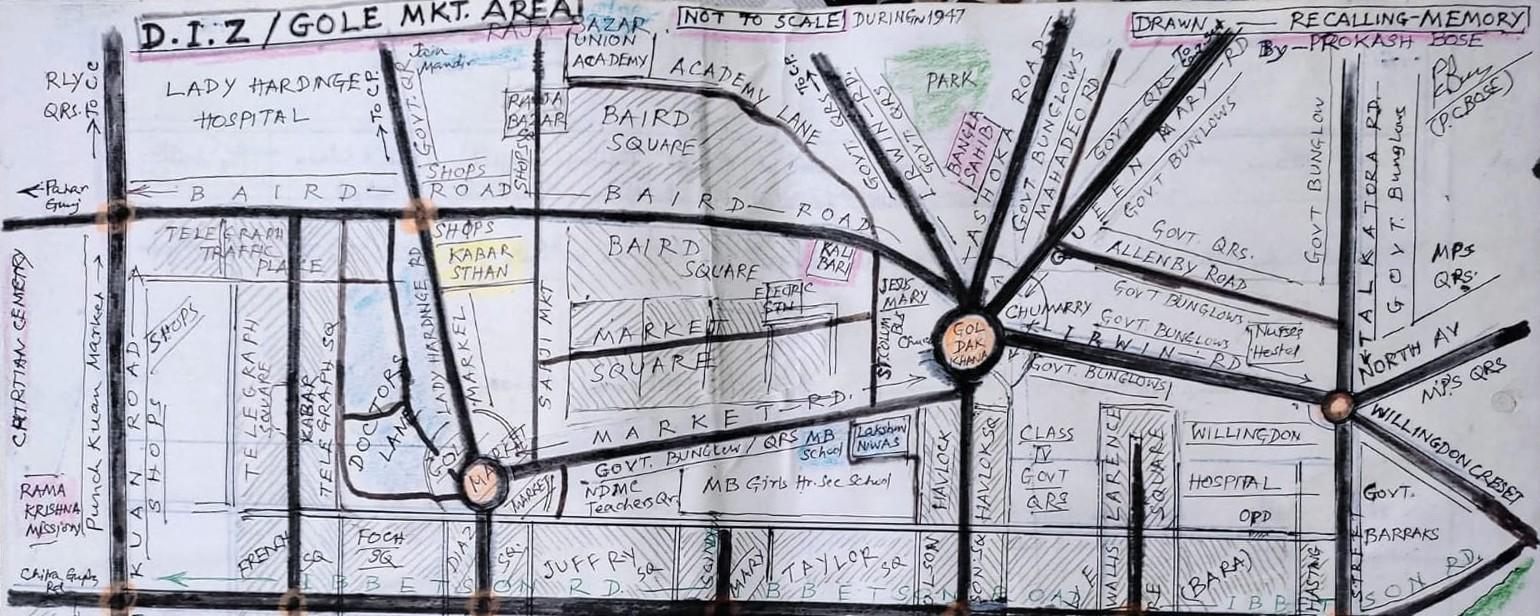
Detail of a hand-drawn map of the DIZ / Gole Market area by the late P. C. Bose; the full map is at the end of the column. Photograph by Vineet Sharma.
Connaught Place, or CP as it is popularly and fondly known, has always been in the middle of everything in my life. I was born in the coveted PIN code 110 001, and I went to school in the DIZ area (the Delhi Imperial Zone, in the old-school expansion). As a result I roamed freely, bunked school and watched morning shows at Regal, Rivoli, Plaza or Odeon.
In the mid-eighties, many of the smarter students carried a spare shirt or T-shirt, as many cinemas denied entry to students in school uniform. Sometimes a PTI (physical training instructor) sir from an adjoining school, dreaded by all the students, would conduct a raid during the interval with his referee's whistle and a flash torch, rounding up every student in sight. It was fun.
Another usual haunt for us harmless souls was video games, and Palika Bazaar was the most happening place for the action. There were small five-foot wooden cabinets with a built-in console playing loud, captivating sounds, coupled with a steering wheel for car racing or a gun for shooting enemy tanks. These games were damn addictive and programmed in such a fashion that no one could ever cross the third level, with everyone trying and losing their meagre daily allowance. Every third shop had at least one or two such machines. Their primary business could be selling anything, but everyone wanted a piece of the action in making quick money. And on top of everything, Palika Bazaar was fully air-conditioned.
I firmly believe that destiny plays an important role, and that certain places associated with us are a constant source of serendipity. More than half of my life, about thirty impressionable, formative years, was spent in New Delhi. In 1977, when we moved here, we used to live in British-era single-storey dwelling units, in squares named after British officers: Dalhousie, Robert, Lake Square and so on.
It was a beautiful, lush green landscape where trees towered over the single-storey houses, all in symmetrical squares divided by parallel roads, with huge parks, concrete slides and ancient metallic swings within each square. All the houses were identical, with three rooms, a kitchen, a store, a bathroom and a big aangan (courtyard) at the back. And not to miss, there was a big (non-functional) fireplace in the living room, which intrigued me as a child. The fans, lights, switches, wires and plumbing were all from the British Raj era but fully functional.
The rooms were very airy, with skylights and a ceiling about 15 feet high. The connecting rod of the fan was almost six feet long, so that it could disperse air evenly. Each house had a big veranda in the front, with a similar parabola-shaped entrance.
The entire area was lined with lush green trees like silk cotton (semal), jamun, pipal, bargad, arjun and kikar, to name a few. For the local market at Paharganj, horse-carriage tongas used to ply, at Rs 1 for an adult and 50 paise for a child. There were lots of temples, like Birla Mandir and New Delhi Kali Bari, and other places of worship like the Bangla Sahib Gurudwara and the Sacred Heart Cathedral, which are still around in all their glory.
This landscape was something else, without any multi-storey developments, which came into existence in the early eighties. There was hardly any traffic: very few government vehicles, mostly Hindustan Motors Ambassadors, and very few private vehicles. These were old FIATs, old-school Jawa/Yezdi motorcycles, mopeds and the middle-class family favourite, Hamara Bajaj, which commanded a grey-market premium as there was a waiting period of two to three years.
Life was simple. Almost all the people living here were on a nine-to-five, run-of-the-mill routine, doing government jobs with similar earning capacities, the same set of life struggles and endless aspirations.
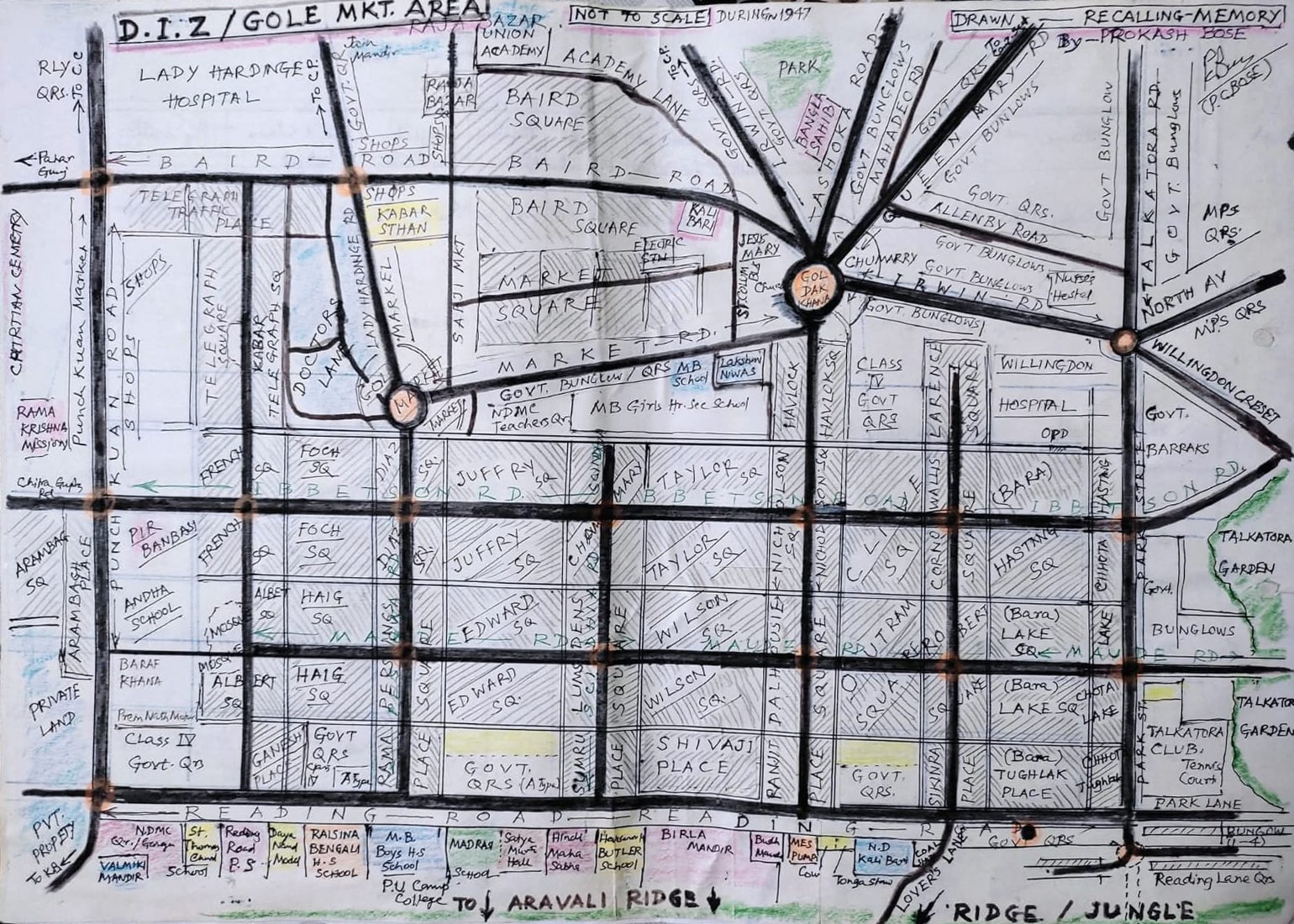
Map of the DIZ / Gole Market area, drawn from memory by the late Shri P. C. Bose, an alumnus of The Union Academy who later taught there before serving as Deputy Director of Education, GNCTD, and Education Officer, CBSE. Vineet calls it a brilliant attempt at remembering and capturing that geography, reproduced with almost 99.99% accuracy. Photograph by Vineet Sharma.
Vineet Sharma is a career salesperson, with over three decades in sales and marketing and the last two in strategic sales and leadership roles, across computing, IT infrastructure, telecom and enterprise technology, education and solar energy. He has spent his working life in Delhi NCR, and is still at it.
Editor’s Note: The column is Vineet’s recollection of Connaught Place and the Gole Market government colony in the late 1970s and 1980s. Our editorial research found official records that support several of its details. Palika Bazaar, the underground air-conditioned market below Connaught Place, was set up in the 1970s (Delhi Tourism; NDMC council resolution, May 2009). The sectors of the DIZ Area appear among the general-pool government quarters in Delhi (Lok Sabha, 31 July 2001), and Gole Market itself is described as a colonial-era market at a nodal point of Lutyens’ plan for the Imperial capital (NDMC council resolution, May 2009). On scooters, the Lok Sabha was told that orders booked with dealers for Bajaj-150 and Bajaj Super scooters stood at 3.70 lakh on 1 January 1979 (Lok Sabha, 11 April 1979). The records we found use “DIZ Area” without expanding it; the expansion is Vineet’s. The length of the scooter wait and the premium it commanded, the tonga fares, the cinema rules, the arcade games and the school raids remain Vineet’s recollection.