
"I Have Never Heard of L&D." The Market Is Agreeing.

From The Designer, an Eduriti original. Episode 1.
Sanjay Mukherjee, 1 April 2026
On the morning of 31 March 2026, tens of thousands of Oracle employees opened their inboxes to find a five-line email from "Oracle Leadership." No call from HR. I doubt if any manager called. And it seems their access to company systems was cut cold there and then.
According to a TNW report, TD Cowen estimates between 20,000 and 30,000 people were cut in that single morning — roughly 18% of Oracle's global workforce of approximately 162,000. The largest layoff in the company's 48-year history. Oracle's net income last quarter: up 95%, reaching $6.13 billion. Remaining performance obligations: $523 billion, up 433% year on year. According to TNW's analysis, this is not a company in distress. It is a profitable company eliminating up to 30,000 people to free up $8–10 billion in cash flow to fund AI data centre infrastructure. On the day of the layoffs, the stock edged up 5%.
This is what capital rotation looks like when it has fully committed to a direction.
A couple of weeks before Oracle's 6am email arrived in those inboxes, I was speaking to a childhood friend, a serial entrepreneur who has been building companies based on Machine Learning and AI for the last decade. I was explaining that my new product suite was for L&D departments and he asked: "What is L&D?"
"Learning and Development."
"What does that mean?"
"L&D is a department that manages the processes of training and skill development. Like in your company there must be a training division right?"
"We hire people with skills and the ability to learn. In all my companies, we work and learn and apply. I have never heard of L&D. Tell me, have you ever been trained for a job?"
That was the most honest conversation I had in a long while. And it took me back to my core. I always got work because of what I was able to do. And in the entire 34 years of my work life, I have never been in a company that trained me on any skill. I learned on my own time at my own cost because learning is a part of one's acquisition of skills. That is why I have multiple qualifications and I have hundreds of projects in my portfolio that I built while I was getting the education and working evenings to apply my education.
On the other hand, I have always been training people on the job. So when and how did L&D develop as an industry?
The answer may not be required because the question that was not asked in corporate boardrooms has now been answered by the market: why does any organisation maintain a department whose primary function is to decide what people need to learn, commission its production, and distribute it through an administered system — when the workforce has free access to a better, faster, more personalised version of all of it, instantaneously?
The Market Reward
The correlation between AI-driven headcount reduction and market performance is no longer ambiguous. It is directional, consistent, and accelerating.
| Company | Action | AI Capital Commitment | Market Response |
|---|---|---|---|
| Oracle | Cut 20,000–30,000 jobs on 31 March 2026 — roughly 18% of global workforce — net income up 95% last quarter | $156bn AI infrastructure commitment; cuts free up $8–10bn in cash flow (TD Cowen via TNW) | Stock +5% on day of layoffs (TNW, Mar 2026) |
| Amazon | Cut 30,000 corporate roles across two quarters — 14,000 in Oct 2025, 16,000 in Jan 2026 | $125bn full-year capex 2025; higher spend guided for 2026 | Stock +3% on January announcement (TimeTrex, Jan 2026) (CNBC, Jan 2026) |
| Atlassian | Cut 1,600 jobs (10% workforce) — cloud revenue +25%, RPO +40% — from a position of strength | Restructuring to fund AI and enterprise sales push | Shares rose in after-hours trading on announcement day (TechRepublic, Mar 2026) |
| Block | Cut 40% of workforce — 4,000 jobs — gross profit up 24% YoY at time of announcement | Moving to AI-automated operations; production code per engineer up 40%+ since September | Stock closed +17% on announcement day (Fortune, Feb 2026) (CNBC, Feb 2026) |
| Meta | 2023 Year of Efficiency — 20,000 jobs cut across late 2022 and 2023 | Began AI infrastructure pivot | Stock +194% in 2023 — strongest annual performance on record (Stocktwits, Mar 2026) |
| Meta | Signalled 20% cut (~16,000 jobs), March 2026 | $115–135bn AI capex planned for 2026 — roughly double 2025 | Retail traders called it bullish before announcement was confirmed (CNBC, Mar 2026) |
The strategic logic behind these numbers is stated openly, not inferred. Amazon's CEO Andy Jassy wrote to employees that AI would mean the company needed fewer people doing some jobs being done today. Meta's CFO reported that output per engineer increased 30% since the start of 2025 through agentic AI tools, with power users seeing 80% year-on-year output gains (Investing.com, Mar 2026). Zuckerberg said it plainly: projects that used to require big teams can now be accomplished by a single, very talented person. Jack Dorsey was the most direct of all: "Intelligence tools have changed what it means to build and run a company. I think most companies are late."
By end of March 2026, over 60,000 tech workers had been cut across more than 200 companies — 668 people every day (TrueUp Layoffs Tracker, Mar 2026). AI was cited in over 12,000 US job cuts already this year, according to Challenger, Gray & Christmas (InvestorPlace, Mar 2026). The hyperscalers — Amazon, Alphabet, Microsoft, Meta — are collectively committed to $700 billion in AI investment in 2026 (CNBC, Mar 2026). They are not cutting because times are hard. They are cutting because the calculus of what generates returns has changed — and unlike most structural shifts, this one is being stated out loud in shareholder letters.
The Market Retribution
The market does not only reward cuts. It is also punishing the failure to demonstrate that AI is restructuring the cost base and amplifying output. Revenue growth, absent that narrative, is no longer sufficient.
| Company | Situation | Market Response |
|---|---|---|
| Adobe | Subscription growth decelerated to 9% YoY — slowest in years. Churn rising as AI tools reduce the creative headcount that drove licence revenue. No significant restructuring announced. | Stock -5% after-hours on Q4 2025 earnings. Downgraded by Oppenheimer. (Ad Hoc News, Mar 2026) |
| Salesforce | Revenue growth slowing to ~9%. Core business model tied to user seat count — directly threatened as AI enables fewer licences to accomplish more. Agentforce characterised as premature by analysts. Stock down ~27% year-to-date. | Stock -5% February 2026, three consecutive weeks of decline in March. Downgraded to underperform. (247WallSt, Mar 2026) |
| Workday | AI-driven efficiencies enabling seat-count contraction across enterprise clients — teams of five doing the work of ten, reducing licence demand directly. No credible AI transition narrative established with investors. | Stock stagnated. Analysts flagging structural threat to SaaS revenue model. (Financial Content, Jan 2026) |
Goldman Sachs has warned that financial institutions alone could see 14% headcount reductions over three years as AI adoption accelerates, with the tech sector facing 10% (Fortune, Oct 2025). These are not projections of distress. They are efficiency targets the market is already pricing in — whether or not the companies have formally announced them.
The pattern across both tables is the same signal read in two directions. Companies demonstrating AI-driven productivity gains are being valued upward. Companies generating revenue but failing to show AI is reshaping their cost structure are being discounted or punished. The market has established a preference, and it is not subtle.
Every function built primarily on people — without a productivity argument that AI cannot replicate — is now a line item under implicit review. The timeline is the only variable.
The eLearning Industry: A Brief Autopsy
For thirty years the eLearning industry converted client content into SCORM packages, called the workflow instructional design, and invoiced accordingly. That production model is now automated. The eulogy can wait.
How is the industry responding?
Most eLearning companies are releasing products built on prompt engineering — interfaces that dressed up a prompt, a template, and an LLM API call as a content authoring platform.
Prompt engineering as a meaningful differentiator ceased to be relevant in late 2024.
A few have gone further and are now testing what they call agentic AI solutions — a single agent behind a chat interface, a generate button, a course output. A single agent with a UI in 2026 is not agentic AI. It is a rebadged chatbot.
Meanwhile, the multi-agent ecosystem is now the new normal: orchestrators spinning up specialist agents, parallel autonomous workflows that plan, delegate, execute, evaluate, and iterate without human intervention between steps.
Here is the number that settles the question of whether this is a technology problem or a thinking problem.
One solo founder, working alone across instructional methodology, visual design, business process and engineering simultaneously, built a fully functional AI-coached LMS in six days. A professional-grade storyboarder and end-to-end SCORM development pipeline — secure, enterprise-grade infrastructure — in seven. Thirteen days. One person.
There will be many who will follow that model, if not already.
The Demand Signal vs The Market Reality
| The Demand Signal | The Market Reality |
|---|---|
| $102 billion spent annually on corporate training globally (Training Orchestra, 2025) | Demand for training products and services expected to shrink in 2026 (Training Industry, Feb 2026) |
| Large US companies increased training spend 24% even as other budgets contracted (AIHR, Oct 2025) | Revenue going to platforms, AI tools, and frontier LLMs — not incumbent vendors |
| 85% of business leaders expect AI to surge skills-development needs within 3 years (Training Orchestra, 2025) | Most eLearning vendors still selling prompt-wrapped SCORM or single-agent chatbots dressed as agentic platforms |
| WEF: 39% of workers' core skills changing by 2030 (WEF Future of Jobs Report, 2025) | L&D functions taking months to build what was needed before the board had finished asking the question |
| 90% of L&D budgets held steady or increased (TalentLMS, Feb 2026) | 50% of organisations report managers lack proper support to activate what L&D produces (LinkedIn Workplace Learning Report, 2025) |
The money is there. The urgency is there. The clients are there. The incumbents are not where the money is going.
That gap — between the scale of the problem and the irrelevance of the suppliers — is the most precise measurement available of what HR, L&D, and the eLearning industry are currently worth to the organisations they are supposed to serve.
Where Do HR and L&D Go From Here?
L&D was built on a premise: that people need structured intervention to develop capability, and that organisations need a function to design, commission, and administer it. Both halves of that premise are now openly questionable. The structured intervention is available instantly from any frontier LLM — personalised, contextual, adaptive, and free. The administration — the LMS, the completion tracking, the vendor management, the reporting cycle, the dashboard — is an architecture built to manage scarcity of access to learning. That scarcity no longer exists. The function built to manage it is still running, still invoicing, still presenting completion rates to a leadership team that has quietly stopped believing they mean anything.
Early this week in Mumbai, in a conversation with the CHRO and Talent Development Head of a fintech company, I eventually asked one question: "What will you do if your board decides to cut 50% of the people? You do know that lean organisations don't have a dedicated L&D or training team right?"
I am sure HR leaders do realise that after they are done managing headcount to ever lower levels and done distributing budgets for training that are not required, their jobs will be next.
The stock prices are not ambiguous. The capital rotation is not subtle. The board question is not theoretical. The next two quarters will probably emphasise the trend.
So what will human resources do when there are too few humans required to resource a company's operations? Hmm?
The Designer Knew
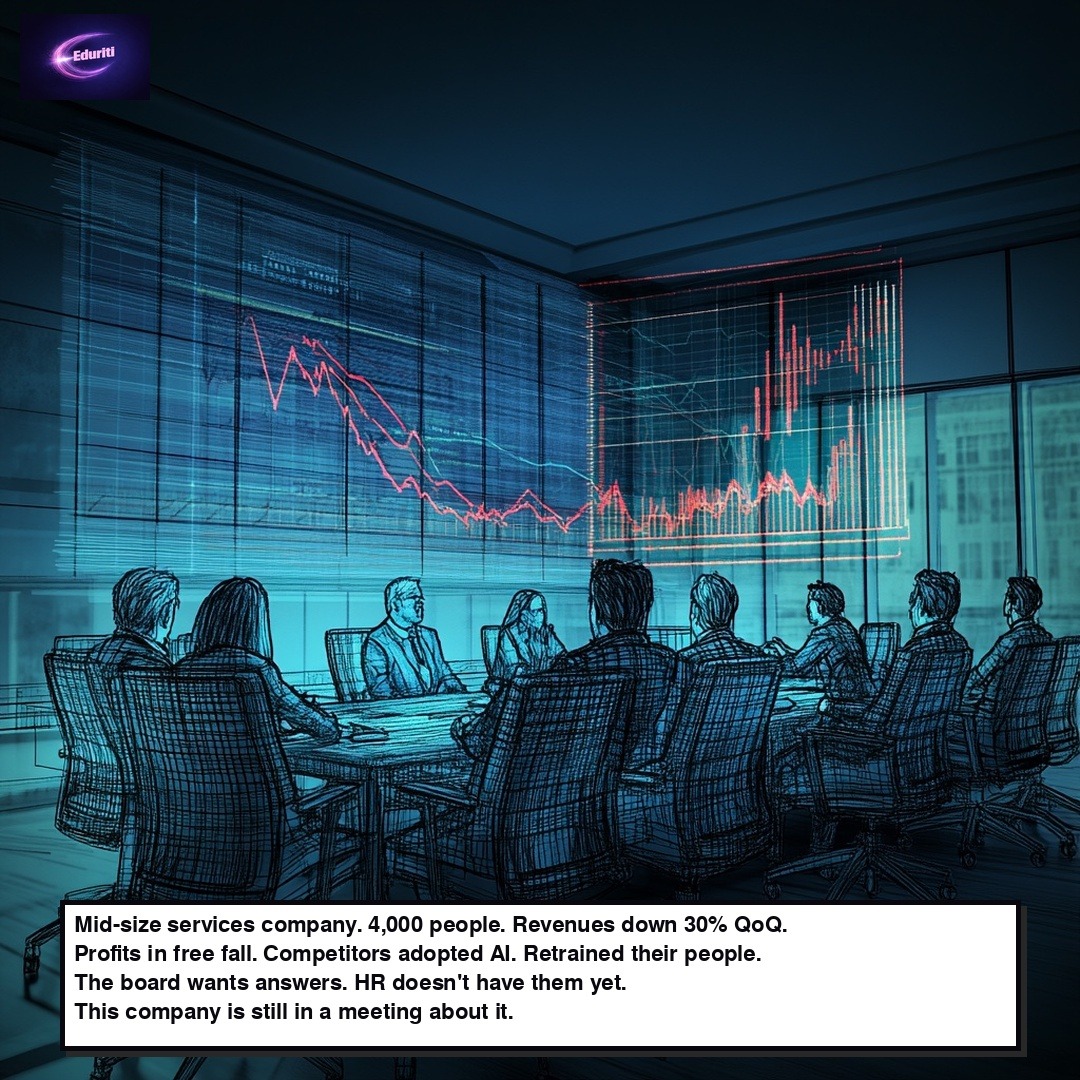
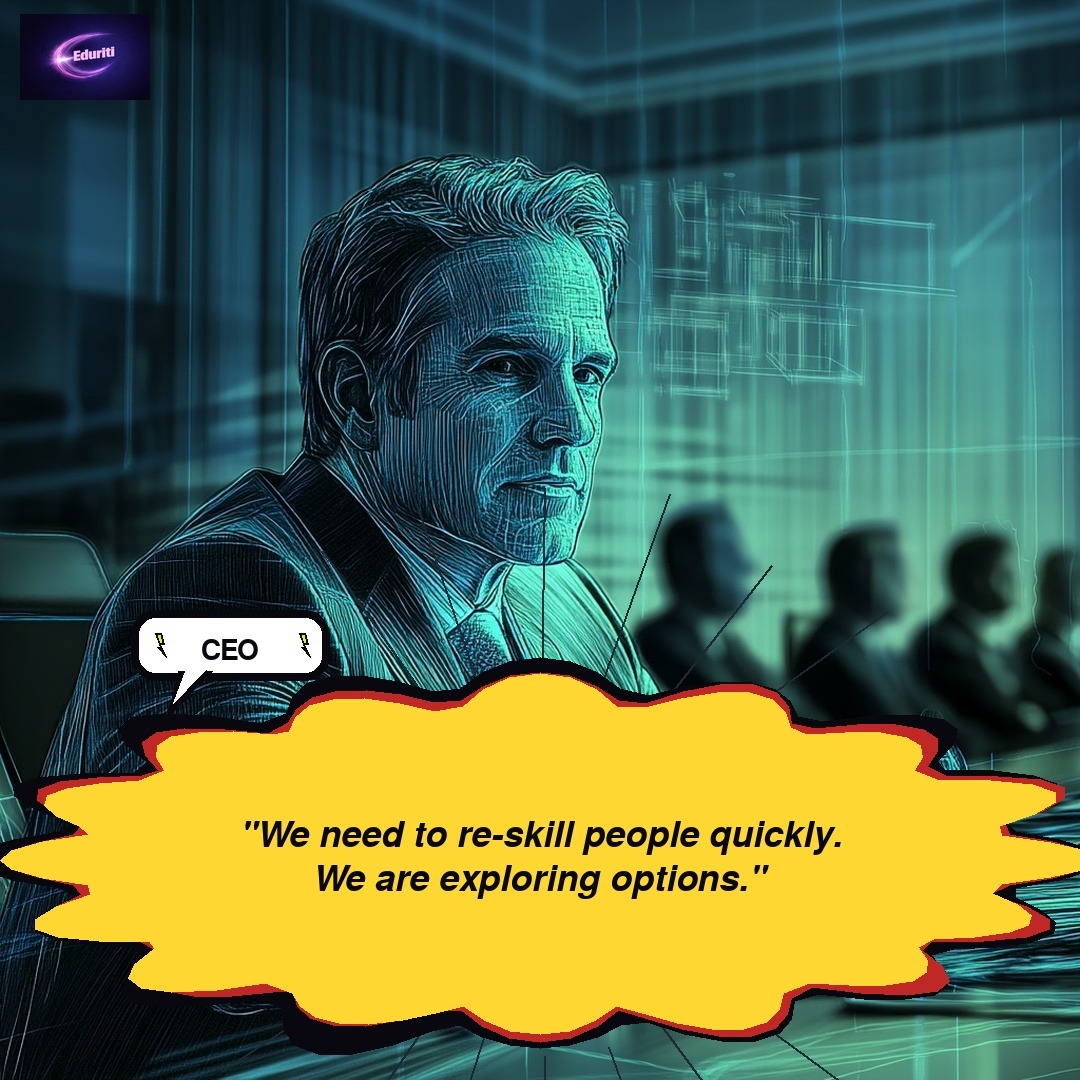
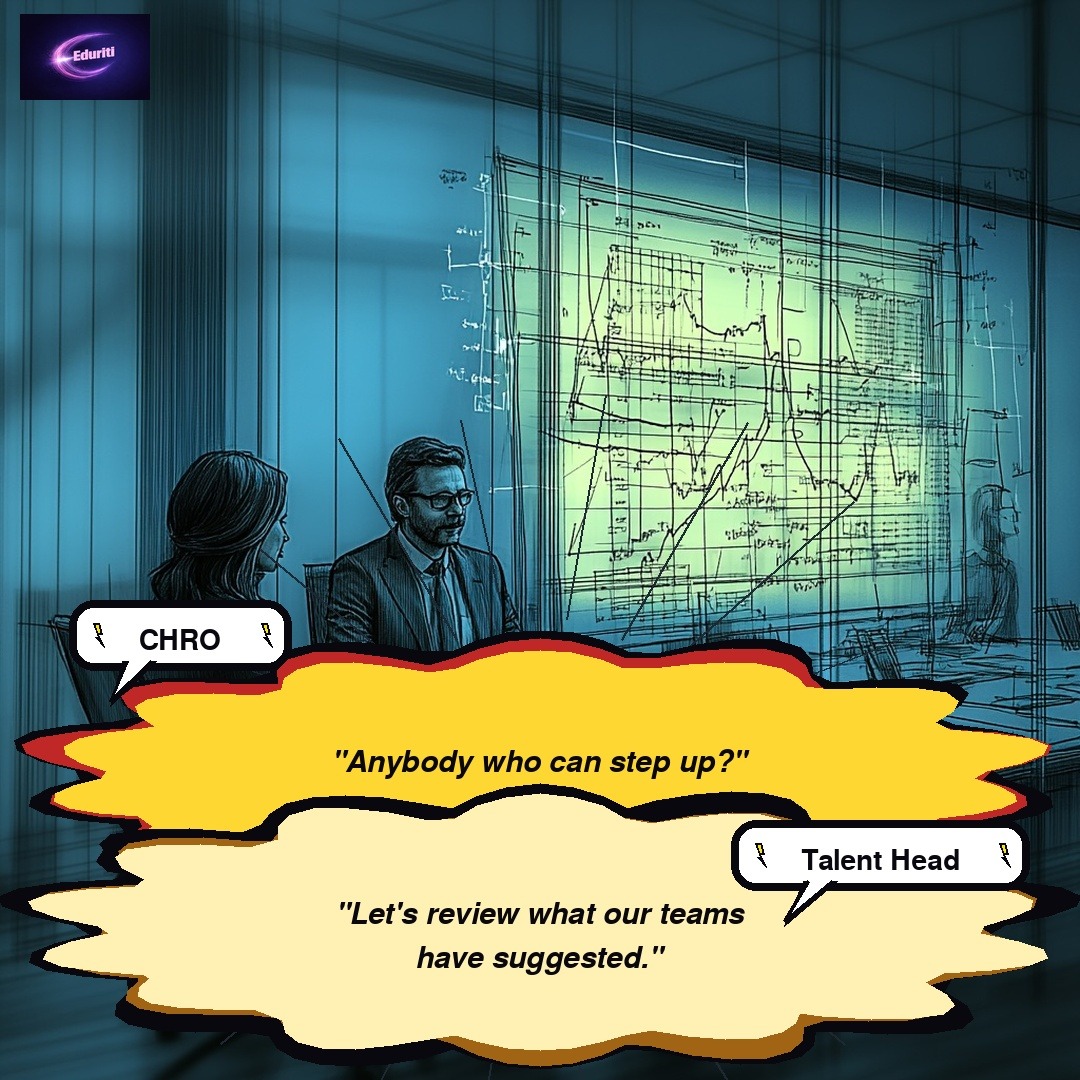
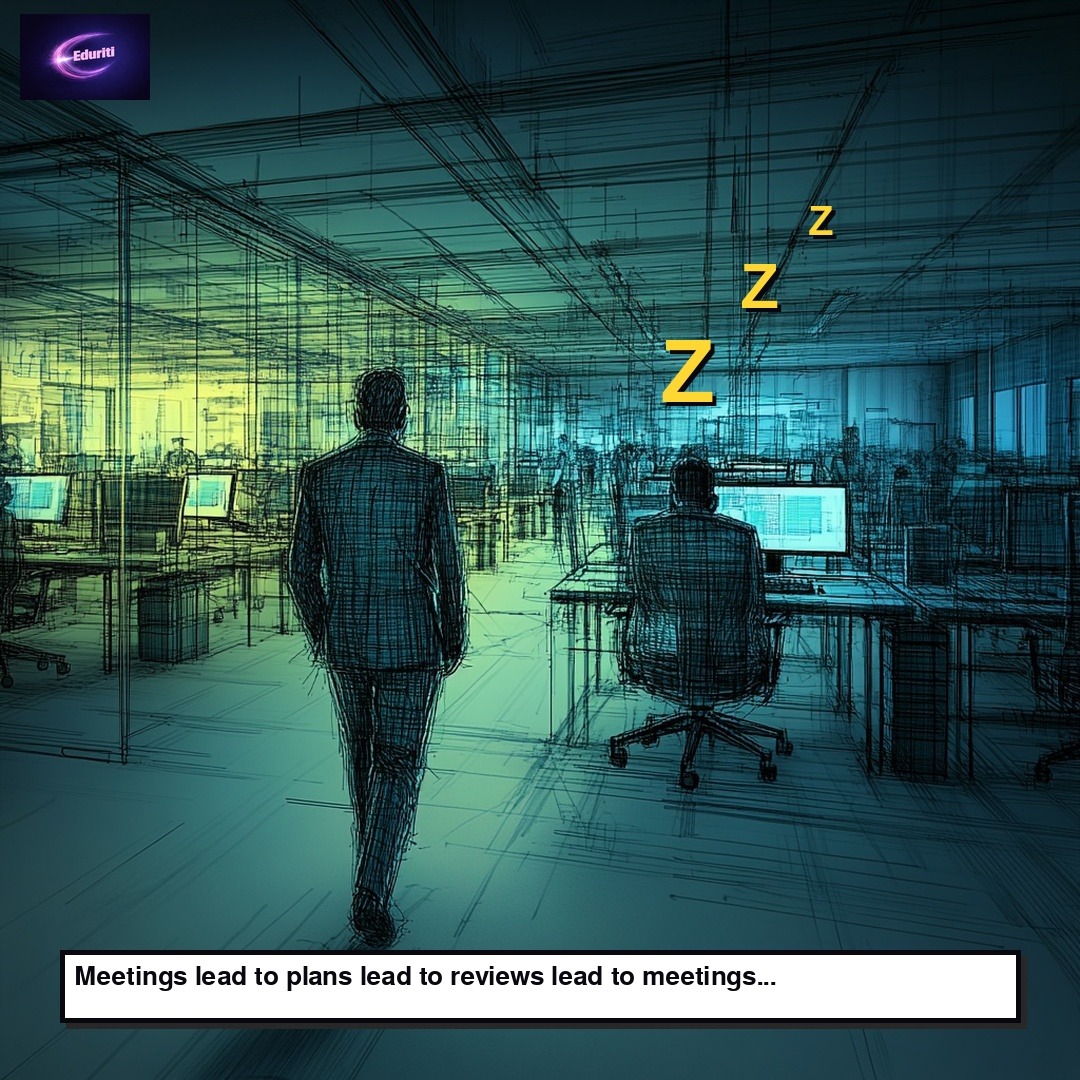
A week before this article was written, Eduriti published Episode 1 of The Designer — a graphic novel series about an instructional designer who understands what the industry hasn't figured out yet. Prophetic, in retrospect.






The Designer — to be continued. Read Episode 1 at Eduriti →