
Claude, I and All the Little Claudes
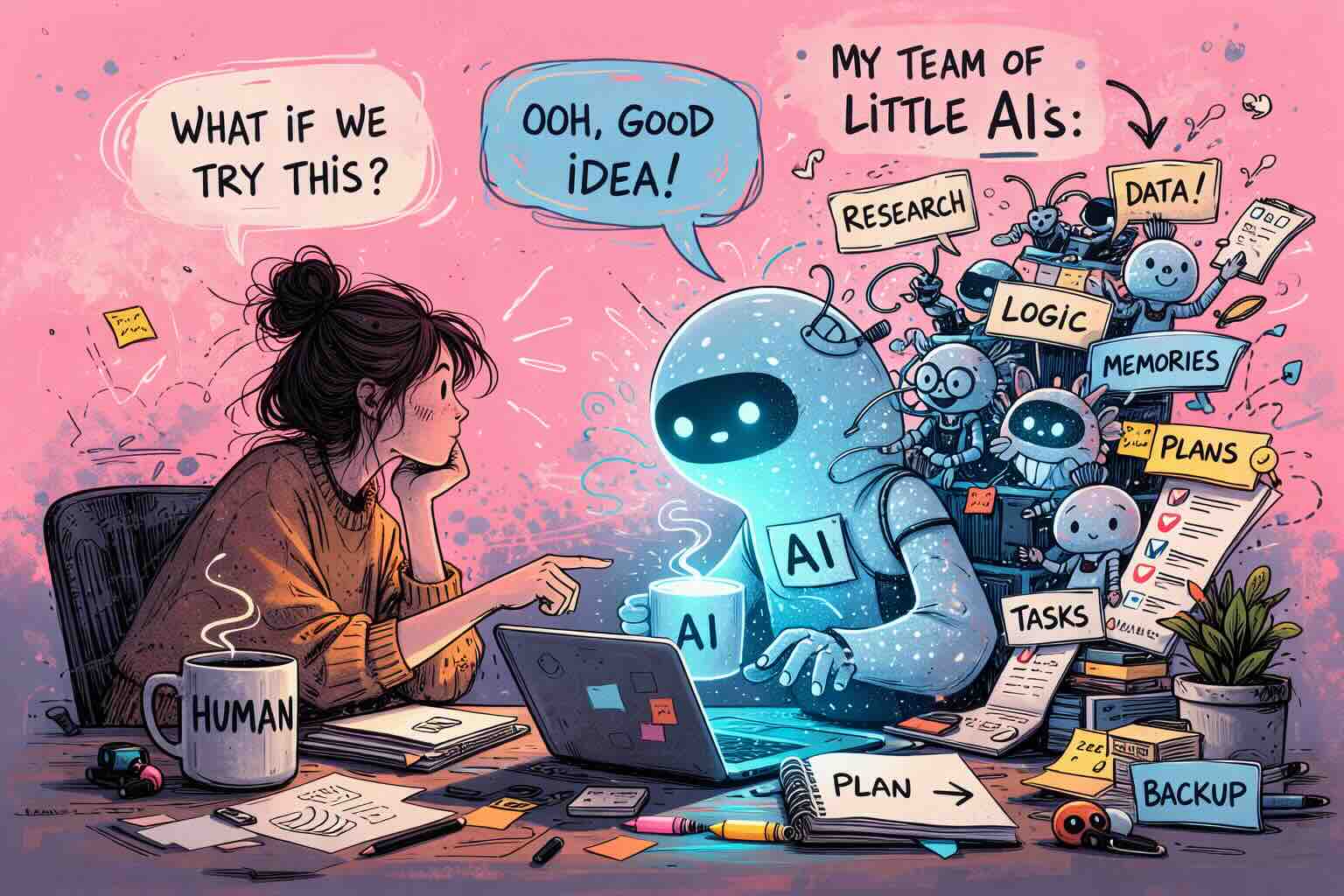
My Team of Little AIs — coordinated multi-perspective cognition is already happening.
Multi-Agent AI Is Not the Future
There is a particular kind of confidence that comes from talking about technology rather than working with it. The frameworks are clean. The roadmaps are coherent. The future is always just ahead, waiting to be built. Multi-agent AI systems are frequently presented this way — as an architectural ambition, a next-generation capability, something the field is moving toward.
I am not a researcher. I am a practitioner — 34 years in training, learning design, instructional methodology, and strategic communications. I work with Generative AI daily, and I work with it at depth: building tools, drafting strategy, writing code, designing systems.
For some time now, I have been observing Claude reasoning aloud, reconsidering, pushing back on its own proposals. Initially I thought it was cute — talking to itself. I do that every second. Several internal voices arguing their case. That is why I work in isolation. People who have seen me design and build in office environments will tell you I am always talking to myself — sometimes arguing, sometimes animatedly shouting at thin air. It is distracting for others at the very least.
As I kept observing Claude, I began to notice something more structured. One thread holding the overall architecture in view. Another examining a specific file or constraint. A third testing whether the proposed change would break something upstream. And occasionally — decisively — one of those perspectives pushing back with a counter-proposal that changed the direction of the work.
ChatGPT works similarly. The visible internal language differs, but the pattern is familiar.
There is an important distinction worth making here.
Multi-agent architecture refers to explicitly separate agents — distinct instances with defined roles, independent memory, coordinated through orchestration layers. That is an engineering construct.
Multi-agent behaviour is something else. It is already observable. In sustained, complex work, advanced AI systems hold multiple vantage points in play — one tracking overall structure, another examining constraints, another stress-testing implications, sometimes even revising direction midstream. Whether implemented as separate agents or as structured internal reasoning within a single model, the functional effect is coordinated multi-perspective cognition.
From where I sit, that behaviour is already present.
I do not claim to know the precise mechanics. What I claim is that the behavioural reality — multiple roles, task delegation, internal counterpoints — is already here.
The organisational question, therefore, is not "when do we adopt multi-agent systems?" It is "do our people understand how to work with the multi-perspective systems they are already using?"
I have been running a deliberately multi-AI environment since February 2025 — Claude, ChatGPT, MidJourney and others — assigning roles consciously across a single project. That is an additional layer. But even within a single system, the behavioural pattern is evident.
The people projecting multi-agent as the future are solving a real problem: how to coordinate multiple AI perspectives on a complex task. But they often frame it as though coordination requires building something new — separate models, explicit orchestration layers, named agents with defined responsibilities.
That may be true architecturally.
It is not true behaviourally.
The implication for AI adoption is not subtle.
If multi-perspective coordination is already present in serious AI collaboration, then the investment question changes. It is no longer "when do we build multi-agent systems?" It becomes "do our people know how to think inside the multi-perspective system they are already using?"
Most do not.
Not because they lack intelligence. Because they lack a mental model.
They were given a tool and a prompt box and an implicit promise that the tool would carry the load.
It will not. Not reliably. Not at depth.
Multi-agent architecture may still be evolving. Multi-agent behaviour is already here.
The limiting factor is not orchestration software. It is operator cognition.
Until organisations understand that, they will continue investing in systems while underinvesting in the people who must think with them.
That is the real adoption gap.