
Beyond Memorisation: Rethinking Education and Evaluation
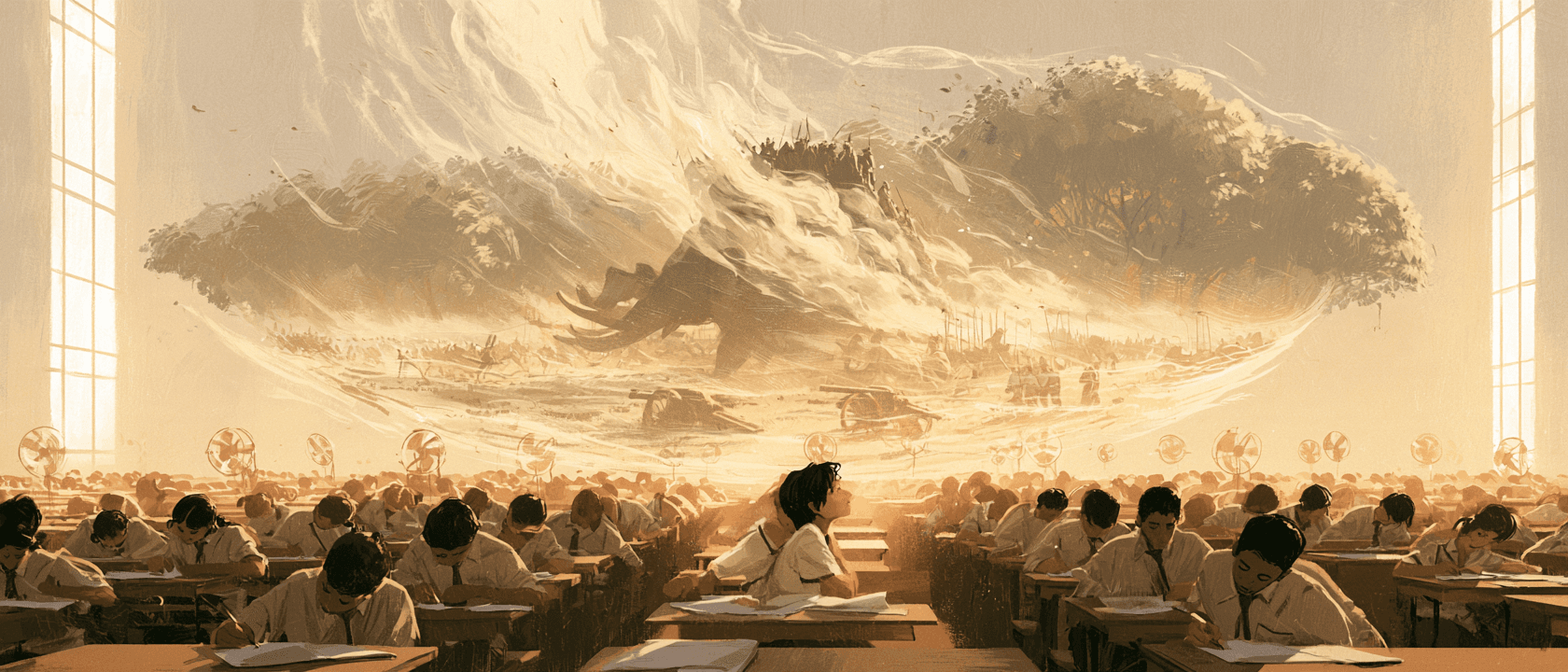
Illustration generated in collaboration with MidJourney.
For decades, education systems in India have relied heavily on examinations that test a student's ability to remember information. Success has often been measured by how accurately facts, formulae, dates, and definitions can be reproduced during an examination. However, in a world where information is available instantly at the touch of a button, it is worth asking whether memorisation should continue to be the primary measure of learning.
Today, it takes only a few seconds to search online and discover who fought the Battle of Plassey. The challenge before education is no longer to ensure that students remember such facts. Instead, it is to develop their ability to interpret information, analyse its significance, and imagine possibilities beyond what is already known.
A more relevant question for today's students would be: What might have been the future of India if the Battle of Plassey had never taken place? Could history have unfolded differently? What alternative strategies might have been adopted by the players involved? Such questions encourage critical thinking, creativity, imagination, and the ability to examine multiple perspectives. These are the skills that will define the leaders, innovators, and problem-solvers of tomorrow.
As discussions emerge around reducing the emphasis on traditional examinations, an obvious concern arises: how will we ensure that learning is actually taking place if there are no tests?
The answer lies in first understanding the true objective of education. Every system must be evaluated based on the outcomes it seeks to achieve. If the objective is merely the transfer of information, then memorisation-based tests may be sufficient. However, if the objective is to create thoughtful citizens, innovative thinkers, and capable problem-solvers, then our methods of evaluation must evolve accordingly.
A useful analogy can be drawn from traffic management.
Traffic police departments frequently publish performance reports highlighting the number of challans issued. Graphs often show year-on-year growth in violations detected and penalties imposed. Such statistics are commonly presented as indicators of improved enforcement.
However, one might argue that this is measuring the wrong outcome.
If the number of violations continues to increase, it could indicate that people are still breaking rules and that roads remain disorderly. The true objective of traffic management is not to maximise the number of challans issued but to ensure safe, smooth, and congestion-free movement of vehicles.
Modern technology offers a better way to measure this objective. GPS-based systems, similar to those used by Google Maps, can monitor traffic congestion in real time. Roads experiencing heavy traffic are highlighted in red, while free-flowing sections remain green. If the performance of a traffic officer were measured by the amount of time roads under their responsibility remained congestion-free, it would align evaluation with the actual purpose of traffic management.
The focus would shift from punishment to outcomes.

Illustration generated in collaboration with MidJourney.
This simple example highlights an important principle: when we measure the wrong thing, we often encourage the wrong behaviour. When we measure the right objective, we encourage actions that genuinely improve performance.
The same principle should be applied to education.
Rather than evaluating students on how much information they can recall, we should evaluate them on their ability to apply knowledge. We should ask whether they can analyse problems, connect ideas across disciplines, develop innovative solutions, and demonstrate practical understanding of the subjects they study.
India, like every nation, faces several long-standing challenges in areas such as urban planning, environmental sustainability, healthcare, transportation, agriculture, and public administration. These challenges should not be viewed solely as governmental responsibilities. They should become learning opportunities.
Educational institutions can transform these real-world problems into academic challenges. Students studying science, engineering, economics, history, public policy, and other disciplines can be encouraged to investigate these issues, propose solutions, and test their ideas. Their progress can then be assessed based on research, creativity, collaboration, problem-solving ability, and the practical viability of their proposals.
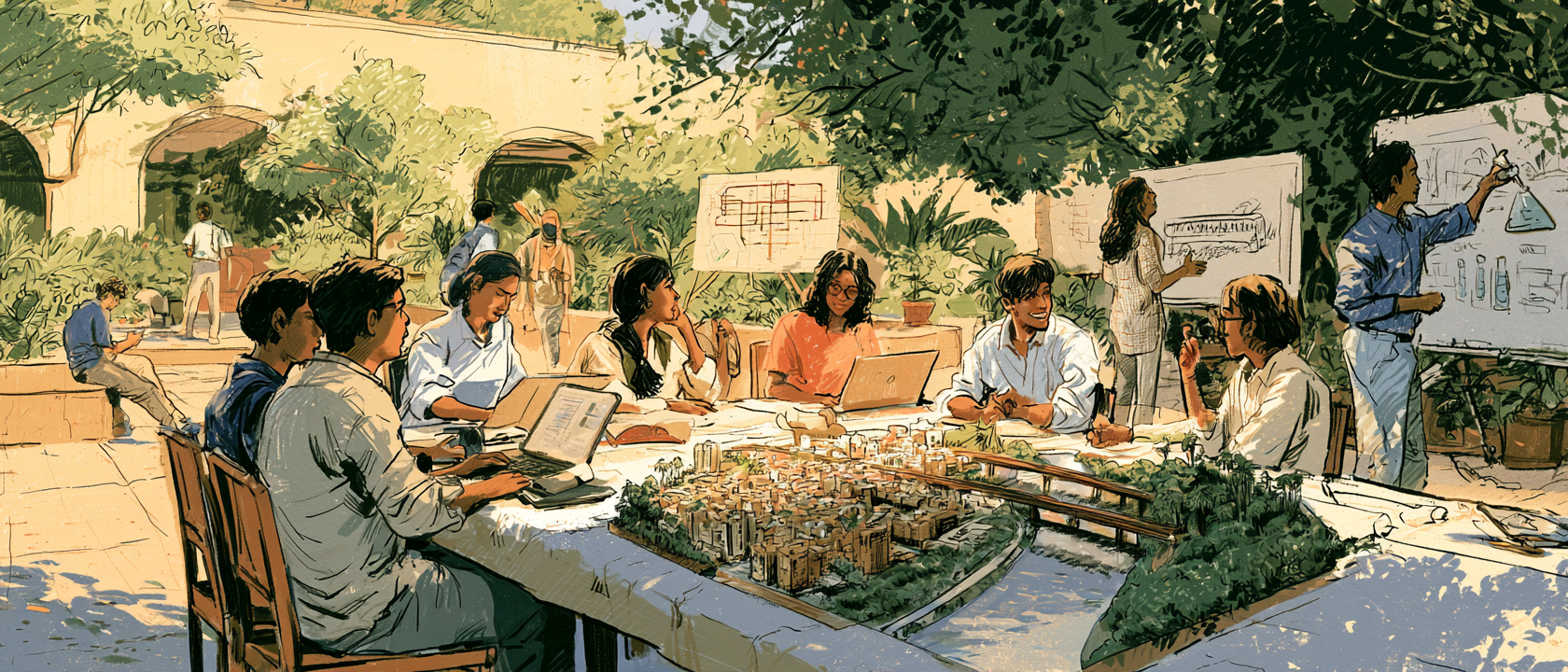
Illustration generated in collaboration with MidJourney.
Such a system would not merely produce graduates with degrees. It would produce citizens capable of contributing meaningfully to society.
The purpose of education should not be to create individuals who can recall answers for a few hours in an examination hall. Its purpose should be to create individuals who can ask meaningful questions, challenge existing assumptions, and develop solutions to problems that affect millions of people.
The future of education lies not in rewarding memory alone, but in nurturing imagination, application, and innovation. Knowledge remains important, but its true value is realised only when it is used to create a better future. In the twenty-first century, the defining measure of learning should not be what students know, but what they can do with what they know.
(Shashikant Jugran is a specialist in business process reengineering, an orator, mentor, and travel industry leader with three decades of experience. A multi-disciplinary professional, Shashikant is a civil engineer who transitioned into management through an MBA in Marketing with a Minor in Human Resources. His illustrious career has spanned leadership roles in Amadeus, Bird Group, RezNext, Yatra, and he currently serves as the Chief Operating Officer at BirdRes Technologies Private Limited, based in Gurgaon.)