
Andheri to Thane, Ladies Second Class
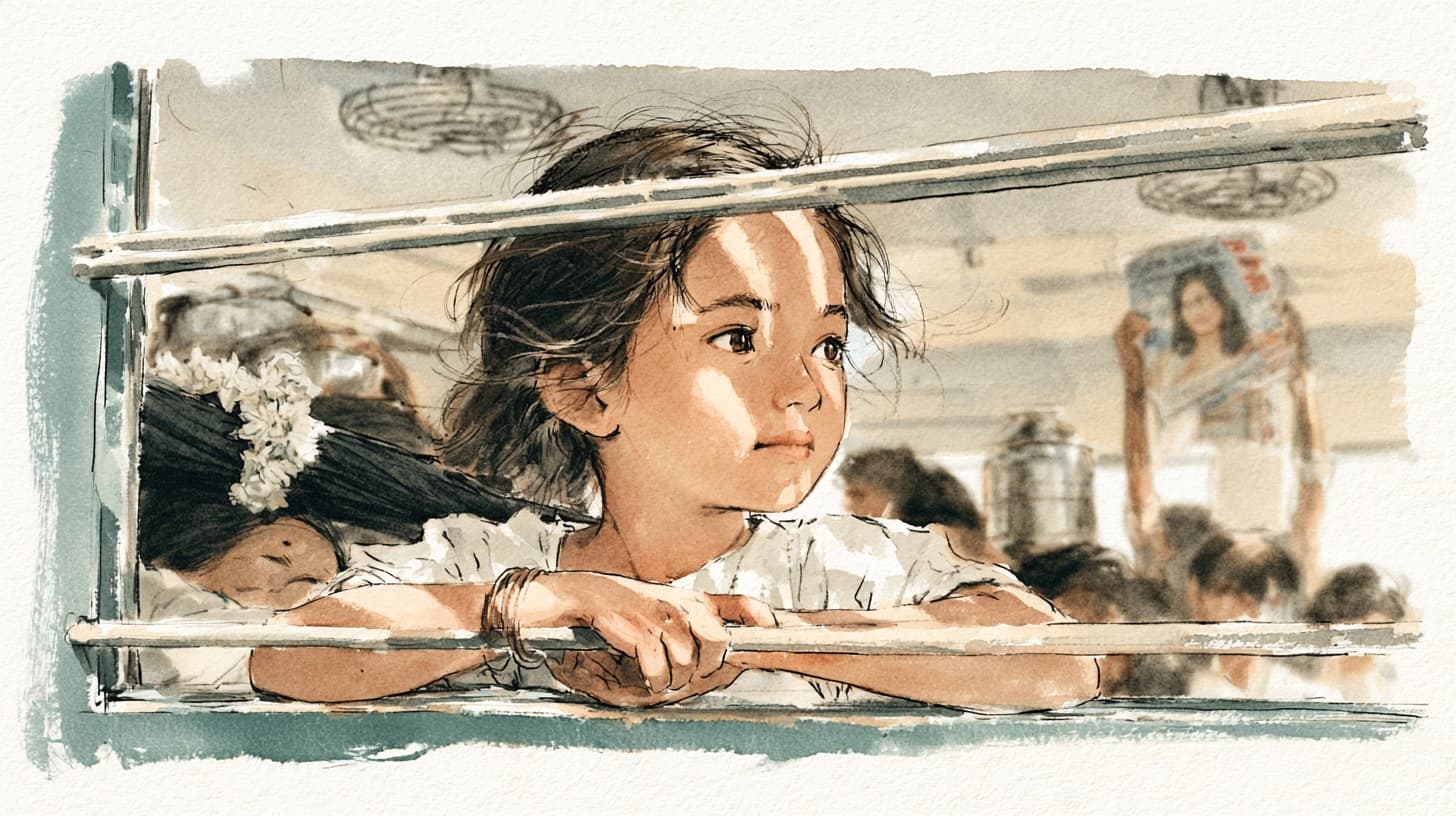
Illustration generated with MidJourney.
A Saturday, sometime in the late nineteen eighties.
Mum has my wrist, not my hand — the wrist, because a hand can slip — and we get in while the train is still deciding whether to stop.
Inside, the ladies' compartment is doing what it always does: rearranging itself without discussion. A woman shifts six inches so Mum can sit, and six inches turns out to be exactly enough. Bags go up on the hooks. The fans in their wire cages turn their heads slowly, like they're looking for someone. I am put by the window, which is the one privilege of being seven.
Then Vile Parle, and the whole compartment lifts its chin at once.
It comes in through the window before the station does — warm, sweet, milky, the smell of something baking in enormous quantities, biscuits by the lakh, and it fills the carriage the way music fills a room. A woman across from me closes her eyes. Nobody says anything about it. Everybody notices. For four seconds, the train is inside the smell, and then the platform slides past and it's gone, and I keep my nose at the window anyway, in case.
The compartment sells things between stations. A woman comes through with gajras looped over her forearm, and where she has been, the air stays white and sweet with mogra for a long minute after. Another has plastic clips and safety pins and cards of glass bangles that she snaps against her palm to make you look. Hairpins. Bindis in sheets, like stamps. Mum buys nothing and looks at everything, which I understand to be a skill.
At Dadar, we change. Down the stairs, over the bridge, into the crush, her grip on my wrist tightening without her saying a word, and then the Central line, which is a different country. Here, the women have brought work with them. Two of them are snapping beans into a newspaper on their laps. Someone is picking through coriander. And somewhere near the door, a group starts up a bhajan, a dholak from nowhere at all, the manjira keeping time with the rails, and by Kurla half the compartment is singing and the other half is not, and neither minds.
I look at them. The one asleep, whose head tips forward and comes up, tips and comes up, and who will wake by herself at exactly her station without anybody telling her. The one reading a magazine with a film star on the cover, holding it with one hand, holding the pole with the other, not touching the seat. And the one near the door in a cotton sari, pleats sharp as paper, the pallu pinned at the shoulder so precisely that the train cannot do anything about it — not the lurch at Vidyavihar, not the crowd at Ghatkopar — and I think: that. I want to be that. I want to be a woman who knows which station is coming without looking, who stands up one moment before she needs to, who carries a steel dabba and a folded umbrella and gets where she is going.
At Thane, Mum is on her feet before the train slows, and so, half a second later, am I.
They tell me the Vile Parle ovens went quiet some months ago, and the station smells now of nothing in particular. The compartment is quieter too. Everyone has somewhere else to be — in her ears, in her hand — and the gajras are ordered to the house.
A seven-year-old at that window today would have a very good view and nothing to watch.
Editor's Note: The author conceived this article from her lived experiences and drafted it with assistance from Claude, using her own inputs and reflections.
(Kanchan Shine is a daydreamer with a notebook. She reads more than is sensible, watches people slightly longer than is polite, and has never lost the habit of asking how a thing works — or when it quietly stopped working that way. She's an author and former entrepreneur, now serving as Chief Learning and Innovation Officer for Hurix Digital, where her weekdays go to learning design and artificial intelligence. She's also the author of Sticky Learning: From A to Z. Here, she's off duty — writing about whatever she's noticing at the moment.)